Sunday, 25 April 2021

Strategy Montgomery and Porter (1979)

“Andrews and Christensen identified a pressing need for a holistic way of thinking about an enterprise. They articulated the concept of strategy as a tool to for doing so.” (Montgomery and Porter, 1979, p.xii).


“The central concept in this early work was the notion of fit between the unique capabilities of a company and the competitive requirements of an industry that distinguished it from others. The challenge for management was to choose or create an environmental context where the company’s distinctive competence and resources could produce a relative competitive advantage.” (Montgomery and Porter, 1979, p.xii). “Present research continues to affirm the important role industry conditions play in the performance of individual firms. (…) average industry profitability is, by far, the most significant predictor of firm performance. It is far more important than market share  and much more important than the extent of a firm’s diversification.” (Montgomery and Porter, 1979, p.xiv).


Functional strategy: “internal consistency – the extent to which a firm’s plan and policies reinforce each other and can be mutually achieved.” (Montgomery and Porter, 1979, p.xvi ).


“Business strategists can use their imagination and ability to reason logically to accelerate the effects of competition and the rate of change.” (Henderson, 1979, p.4). “Can evolution be planned for business? That is what strategy is for.” (Henderson, 1979, p.5).


“Chasing market share is almost as productive as chasing the pot of gold at the end of the rainbow. You can never get there. Even if you could, you would find nothing. If you are in business you already have 100% of your market. So do your competitors. Your real goal is to expand the size of your market. But you will always have 100% of your market, whether it grows or shrinks.” (Henderson, 1979, p.5). “Market share is a meaningless number unless a company defines the market in terms of the boundaries separating it from its rivals. These boundaries are the points at which the company and are equivalent in a potential customer’s eyes. (…) The competitor that truly has an advantage can give the potential customers more of their money and still have a larger margin between its cost and its selling price.” (Henderson, 1979, p.6).


“Strategic competition compresses time.” (Henderson, 1979, p.6).“Natural competition works by a process of low-risk, incremental trial and error. Small changes are tried and tested. (…) But unmanaged change takes thousands of generations. (…) By committing resources, strategy seeks to make sweeping changes in competitive relationships.” (Henderson, 1979, p.6).


“Cutting-edge Japanese companies today are capitalizing on time as a critical source of competitive advantage: managing time the way most  companies manage cost, quality or inventory.” (Stalk, 1979, p.39). “For these leading companies time has become the overarching measurement of performance. By reducing the consumption of time in every aspect of the business, these companies also reduce cost, improve quality, and stay close to their customers.” (Stalk, 1979, p.49).


“Because when the focus of attention is on ways to beat the competition, it is inevitable that strategy gets defined primarily in terms of the competition.” (Ohmae, 1979, p.62). “Competitive realities are what you test possible strategies against; you define them in terms of customers. Tit-for-tat responses to what competitors do may be appropriate, but they are largely reactive.(…) It also takes shape in the determination to avoid competition whenever and wherever possible” (Ohmae, 1979, p.62). “Getting back to strategy means getting back to a deep understanding of what a product is about.” (Ohmae, 1979, p.70).


“If you ask people whether they want their coffee in ten minutes or seven, they will say seven of course. But it’s still the wrong question. And you end up back where you started, trying to beat the competition at its own game.” (Ohmae, 1979, p.71).


“Ultimately, the only way to sustain a competitive advantage is to upgrade it.” (Porter, 1979, p.138).“either they (these companies) would make their advantage obsolete, or a competitor would do it for them.” (Porter, 1979, p.138).“But change is an unnatural act, particularly in successful companies; powerful forces are at work to avoid and defeat it. Past approaches become institutionalized in standard operating procedures and management controls.” (Porter, 1979, p.138). “the existing strategy takes on an aura of invincibility and becomes rooted in the company culture. (…) Change is tempered by the fear that there is much to lose.” (Porter, 1979, p.139).


“the uncomfortable truth that innovation grows out of pressure and challenge.” (Porter, 1979, p.160). “A company should seek out pressure and challenge, not avoid them.” (Porter, 1979, p.161).“Early-warning signals translate into early-mover advantage.” (Porter, 1979, p.161).


“The whole project got off the wrong foot. It asked people what features they wanted in a washing machine rather than what they wanted out of life.” (Levitt, 1979, p.198).


“The purpose of business is to get an keep a customer. Or, to use Peter Drucker’s more refined construction, to create and keep a customer. A company must be wedded to the idea of innovation.” (Levitt, 1979, p.203).


“a portfolio of competencies versus a portfolio of businesses.” (Prahalad and Hamel, 1979, p.280). “Core competencies are the collective learning in the organization.” (Prahalad and Hamel, 1979, p.281). “core competence does not diminish with use. Unlike physical assets which do deteriorate over time competencies are enhanced as they are applied and shared.” (Prahalad and Hamel, 1979, p.292).“How strange that SBU managers, who are perfectly willing to compete for cash in the capital budgeting process, are unwilling to compete for people.” (Prahalad and Hamel, 1979, p.294).


“Strategies can form as well as be formulated. A realized strategy can emerge in response to an evolving situation, or it can be brought about deliberately.” (Mintzberg, 1979, p.407). “Actions simply converge into patterns. They may become deliberate, of course, if the pattern is recognized and then legitimated by senior management.” (Mintzberg, 1979, p.408).


“It embodies disciplined unity of purpose, a purpose which – to be powerful – must be clear and worthy of the commitment of energetic and intelligent people.” (Andrews, 1979, p.451). “Such strategy summons up imagination, innovation and a zest for risk.” (Andrews, 1979, p.451). “Nonetheless, imagination exists in all questing organizations and people.” (Andrews, 1979, p.459). “”What’s new?” is a question that should havean unending series of answers in the execution as well as formulation of strategy?” (Andrews, 1979, p.459).


Friday, 5 February 2021

The trusted Advisor – Maister et al. 2000


“You don’t get the chance to employ advisory skills untol you can get someone to trust you enough to share their problems with you.” (Maister et al., 2000, p.ix).

“the way to be a great advisor is to care about your client.” (Maister et al., 2000, p.13). 

“The key point is that trust must be earned and deserved. You must do something to give to other people the evidence on which they can base their decision on whether to trust you. You must be willing to give in order to get.” (Maister et al., 2000, p.18). “building trust. First, it has to do with keeping one’s self interest in check.” (Maister et al., 2000, p.22).

“The potential of trust violation is always there in a trusting relationship. The choice on the par of the advisor not to violate trust is what makes the relationship special.” (Maister et al., 2000, p.24).“I will trust you if I believe that you’re in this for the long haul, that you are not just trying to maximize the short-term benefit to you in each of our interactions.” (Maister et al., 2000, p.26). “I will trust you if you exhibit some form of caring. If you provide some evidence that my interests are as important to you as your own interests are.” (Maister et al., 2000, p.26).


“It is not enough for a professional to be right: An advisor’s job is to be helpful.” (Maister et al., 2000, p.27).

“Suggestions on how to improve always carry the implied critique that all is not being done well at the moment. Yet it is the person hiring you who is often responsible for the current state of affairs.” (Maister et al., 2000, p.28).

“the client is untrained in the professional’s specialty, while the professional may have seen the client’s problem (or variant’s of it) many times before. There is thus an almost constant threat of coming across to the client as patronizing, pompous, and arrogant.” (Maister et al., 2000, p.30).

“In many ways, advisory skills are similar to those of great teaching. A teacher’s task is to help a student get from point A (what they know, understand, and believe now) to point B (an advanced state of deeper undersanding and knowledge). It is poor teaching for the professor to stand at the front of the class and say, “B is the right answer.” (Maister et al., 2000, p.33). 

“To get what you want from someone, you must first focus on giving them what they want.” (Maister et al., 2000, p.51). “As Dale Carnegie said, “The only way to influence someone is to find out what they want, and show them how to get it.” (Maister et al., 2000, p.51).

“Then comes the crucial career transition, from technician to full professional, from content expert to advisor. (…) In contrast, our task as advisors is an “in-person,” “in contact” challenge to help the client see things anew or to make a decision.” (Maister et al., 2000, p.53). “The key to prior career success (technical excellence) can actually become an impediment at this level.” (Maister et al., 2000, p.53). “The kinds of people who typically in professional service firms are often driven, rational, and meritocratic, with a great need to achieve. It is the natural thing for such people (…) to look for confirmation that what they are doing is all right.” (Maister et al., 2000, p.54).

“The trick of earning trust is to avoid all tricks.” (Maister et al., 2000, p.61).

“Humility is not weakness. Serving others does not require us to be servile. Ego strength means not having to have our egos stroked continuously. Recognizing and respecting the strength in others does not diminish our respect or strength.” (Maister et al., 2000, p.139).

“To be professional, we must point out possibilities. Some call that selling. We call it contributing ideas.” (Maister et al., 2000, p.169).

“Following our initial courtship with a client, we begin to enter a very short honeymoon period, where the client feels relieved that someone competent is now at work solving his or her problem. There is a natural evolution to the relationship where those feelings of comfort will quickly transform into feelings of wondering whether their advisros is devoting the time necessary and whether the approach is really going to work. 
Trust is built upon respect, and since respect comes from seeing some performance, it becomes imperative that we find the means to deliver small, fast result to evidence our efforts.” (Maister et al., 2000, p.175). “even compiling a status report can ensure our credibility.” (Maister et al., 2000, p.175).

“We need to be eternally alert for what comes next for the client. What should our client be doing as a result of our work?” (Maister et al., 2000, p.176).

“The relationship manager’s task is to make the team members want to participate actively in serving and nurturing the relationship (not the “account”). This can be done by providing what they often do not find in their regular work, such as challenge and meaning.” (Maister et al., 2000, p.183).


Sunday, 31 January 2021

Hamlet Prince of Denmark – Shakespeare 1996


“King:
But now, my cousin Hamlet, and my son –
Hamlet (aside):
A little more than kin, and less than kind.
King: How is it that the clouds still hang on you?
Hamlet:
Not so, my Lord; I am too much I’th’sun.
Queen: 
Good Hamlet, cast thy knighted colour off,
And let thine eye look like a friend on Denmark,
Do not for ever with thy vailed lids
Seek for thy noble father in the dust.” (Shakespeare, 1996, p.673).

“Polonius: 
This above all, - to thine own self be true;
And it must follow, as the night the day,
Thou canst not then be false to any man.
Farewell; my blessing season this in thee!” (Shakespeare, 1996, p.676).

“Ghost:
But, howsoever thou pursuest this act,
Taint no thy mind, nor let thy soul contrive
Against thy mother aught; leave her to heaven.” (Shakespeare, 1996, p.678).


“Hamlet:
… to me it is a prison.
Rosencrantz: 
Why, then, your ambition makes it one; ‘tis too 
Narrow for your mind.
Hamlet:
O God, I could be bounded in a nutshell, and
Count myself a king of infinite space, where it not
That I have bad dreams.” (Shakespeare, 1996, p.684).


“Hamlet: 
Is it not monstrous, that this player here,
But in a fiction, in a dream of passion,
Could force his soul so to his own conceit,
That, from her working, all his visage wann’d
Tears in his eyes, distraction in’s aspect,
A broken voice, and his whole function suiting
With forms to his conceit? And all for nothing!
For Hecuba!
What’s Hecuba to him, or he to Hecuba,
That he should weep for her? What would he do,
Had he the motive and the cue for passion
That I have? He would drown the stage with tears,
And cleave the general ear with horrid speech;
Make mad the guilty, and appal the free,
Confound the ignorant; and amaze, indeed, 
The very faculties of eyes and ears. 
Yet I,
A dull and muddy-mettled rascal, peak,
Like John-a-dreams, unpregnant of my cause,
And can say nothing; no, not for a king,
Upon whose property and most dear life
A damn’d defeat was made. Am I a coward?” (Shakespeare, 1996, p.687).


“Hamlet: 
To be, or not to be,- that is the question:-
Whether ‘tis nobler in the mind to suffer
The slings and arrows of outrageous fortune,
Or to take arms against a sea of troubles,
And by opposing end them? – To die, - to sleep, - 
No more; and by a sleep to say we end
The heart-ache, and the thousand natural shocks
That flesh is heir to, ‘tis consummation
Devoutly to be wisht. To die, - to sleep; -
To sleep! Perchance to dream; ay, there’s the rub;
For in that sleep of death what dreams may come,
When we have shuffled off this mortal coil,
Must give us pause; there’s the respect 
That makes calamity of so long life;
For who would bear the whips and scorns of time,
The oppressor’s wrong, the proud man’s contumely,
The pangs of despised love, the law’s delay,
The insolence of office, and the spurns 
That patient merit of the unworthy takes,
When he himself might his quietus make
With a bare bodkin? Who would fardels bear,
To grunt and sweat under a weary life,
But that the dread of something after death, - 
The undiscover’d country, from whose bourn
No travellers returns, - puzzles the will,
And makes us rather bear those ills we have
Than fly to others that we know not of?
Thus conscience does make cowards of us all;
And thus the native hue of resolution 
Is sicklied o’er with the pale cast of thought;
And enterprises of great pith and moment,
With this regard, their currents turn awry
And lose the name of action.” (Shakespeare, 1996, p.688).

“King: 
Madness in great ones must not unwatcht go.” (Shakespeare, 1996, p.689).

“Player King:
I do believe you think what now you speak
But what we do determine oft we break.
Purpose is but the slave of memory;
Of violent birth, but poor validity:
Which now, like fruit unripe, sticks on the tree;
But fall, unshaken, when they mellow be.
Most necessary ‘tis that we forget
To pay ourselves what to ourselves is debt:
What to ourselves in passion we propose,
The passion ending doth the purpose lose.” (Shakespeare, 1996, p.692).

“Hamlet: 
I will speak daggers to her, but use none.” (Shakespeare, 1996, p.694).

“King: 
My stronger guilt defeats my strong intent;
And like a man to double business bound, 
I stand in pause where I shall first begin
And both neglect.” (Shakespeare, 1996, p.694).

“Queen:
O Hamlet, thou hast cleft my heart in twain.
Hamlet: 
O, throw away the worser part of it
And live the purer with the other half.” (Shakespeare, 1996, p.697).

“Hamlet: 
I must be cruel, only to be kind,
Thus bad begins, and worse remains behind.” (Shakespeare, 1996, p.697).


“Hamlet:
Sure, he that made us with such large discourse,
Looking before and after, gave us not
That capability and godlike reason
To fust in us unused.” (Shakespeare, 1996, p.699).

“Queen:
So full of artless joy is guilt,
It spills itself in fearing to be spilt.” (Shakespeare, 1996, p.700).

“Hamlet: 
… there’s a special
Providence in the fall of a sparrow. If it be now,
‘tis not to come; if it be not to come, it will be
Now; if it be not now, yet it will come: the readi-
ness is all: since no man knows aught of what he 
leaves, what is’t to leave betimes? Let be. 


Saturday, 30 January 2021

Twelfth night; Or, what you will – Shakespeare 1996


“Viola: 
O Time, thou must untangle this, not I;
It is too hard a knot for me t’untie,” (Shakespeare, 1996, p.648).


“Viola: 
We men may say more, swear more: but, indeed,
Our shows are more than will; for still we prove
Much in our vows, but little in our love.” (Shakespeare, 1996, p.652).

“Malvolio:
Some are born great,
Some achieve greatness, and some have greatness
Thrust upon ‘em.” (Shakespeare, 1996, p.654).

“Sir Toby Belch:
Why, thou hast put him in such a dream, that,
When the image of it leaves him, he must run mad.” (Shakespeare, 1996, p.654).

“Clown: 
Foolery, sir, does walk about the orb like the
Sun, it shines every where.” (Shakespeare, 1996, p.655).

“Sebastian: 
What relish is in this? How runs the stream?
Or I am mad, or else this is a dream;” (Shakespeare, 1996, p.663).

Sunday, 24 January 2021

As you like it – William Shakespeare


“Duke Senior: 

… Are not these woods

More free from peril than the envious court?

Here feel we but the penalty of Adam,

The seasons’ difference; as the icy fang

And churlish chiding of the winter’s wind, 

Which, when it bites and blows upon my body,

Even till I shrink with cold, I smile, and say

‘This is not flattery; these are counsellors

That feelingly persuade me what I am.’

Sweet are the uses of adversity;” (Shakespeare, 1996, p.617).


“Duke Senior: 

Thou seest we are not all alone unhappy.

This wide and universal theatre

Presents more woeful pageants than the scene

Wherein we play in. 


Jaques: 

All the world’s a stage;

And all the men and women merely players:

They have their exits and their entrances;

And one man in his time plays many parts,

His acts being seven age. As, first, the infant,

Mewling and puking in the nurse’s arms.

And then the whining schoolboy, with his satchel

And shining morning face, creeping like a snail

Unwilling to school. And then the lover,

Sighing like furnace, with a woeful ballad

Made to his mistress’ eyebrow. Then the soldier,

Full of strange oaths, and bearded like a pard,

Jealous in honour, sudden and quick in quarrel,

Seeking the bubble reputation

Even in the cannon’s mouth. And then the justice,

In fair round belly with good capon lined,

With eyes severe and beard of formal cut,

Full of wise saws and modern instances;

And so he plays his part. The sixth age shifts

Into the lean and slipper’d pantaloon,

With spectacles on nose and pouch on side;

His youthful hose, well saved, a world oo wide

For his shrunk shank; and his big manly voice,

Turning again into a childish treble, pipes

And whistles in his sound. Last scene of all,

That ends this strange eventful history,

Is second childishness and mere oblivion,

Sans teeth, sans eyes, sans taste, sans every thing.” (Shakespeare, 1996, p.622).


“Celia: 

O, that’s a brave man! He writes brave verses,

Speaks brave words, swears brave oaths, and 

Breaks them bravely, quite traverse.” (Shakespeare, 1996, p.629).


“Phebe:

For I must tell you friendly in your ear, - 

Sell when you can; you are not for all markets.” (Shakespeare, 1996, p.630).


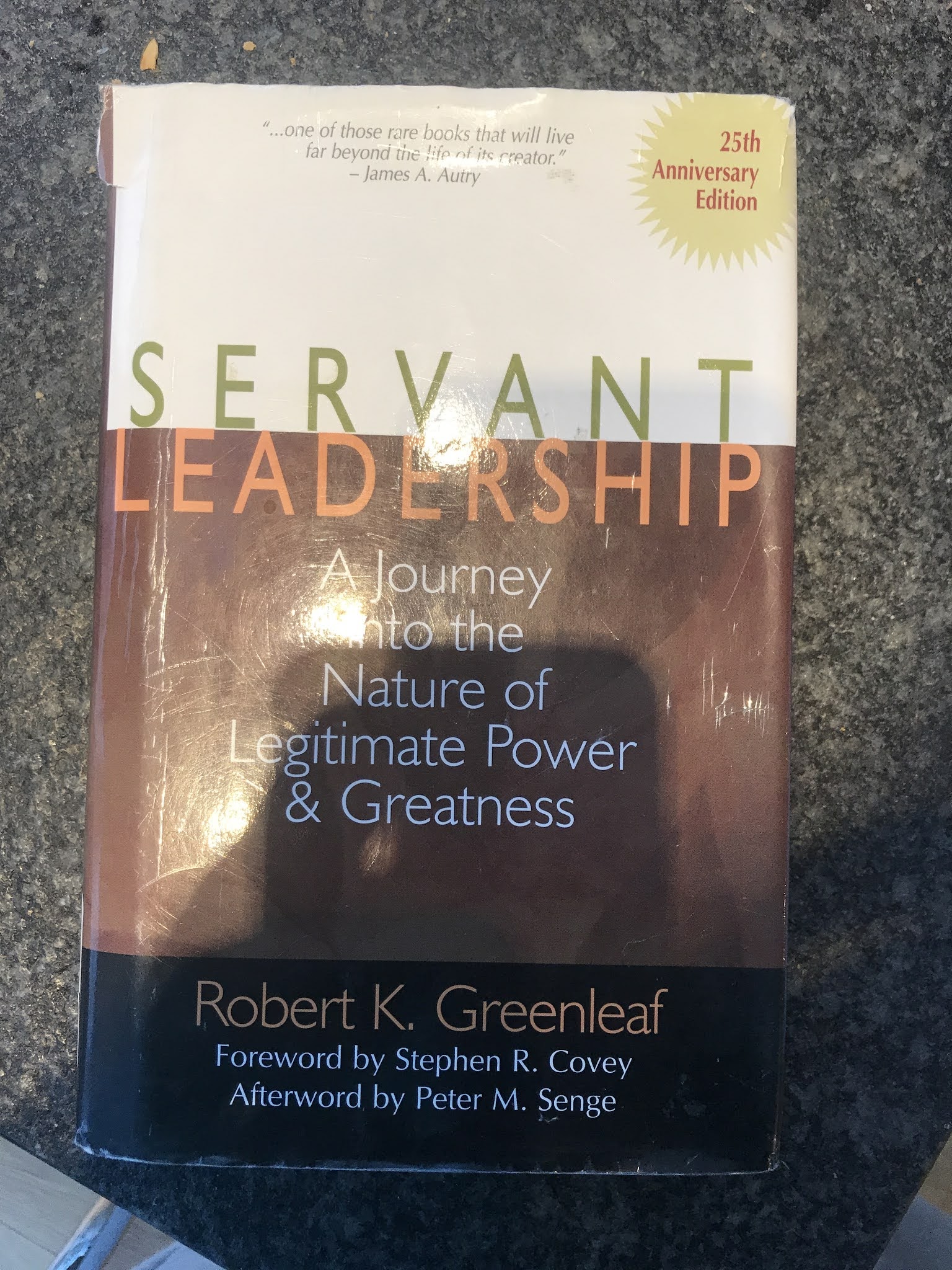
Servant Leadership - Robert K. Greenleaf 1977


“1) The essence of moral authority or conscience is sacrifice – the subordinating of one’s selfe or one’s ego to a higher purpose, cause or principle.” (Covey in Greenleaf, 1977, p.6). “In this sense, both leaders and followers are followers. Why? They follow truth. They follow natural law. They follow principles.” (Covey in Greenleaf, 1977, p.6). 


“The deepest part of human nature is that which urges people – each one of us – to rise above our present circumstances and to transcend our common nature.” (Covey in Greenleaf, 1977, p.1).


The servant as leader. 

“they will freely respond only to individuals who are chosen as leaders because they are proven and trusted as servants.” (Covey in Greenleaf, 1977, p.11 ). “Why would anybody accept the leadership of another except that the other sees more clearly where it is best to go?” (Greenleaf, 1977, p.29). 


“I am reminded of Greenleaf’s acid test of servant leadership. How do you tell a servant-leader is at work? – “Do the people around the person grow?”” (Senge in Greenleaf, 1977, p.357). “Do those served grow as persons? Do they, while being served, become healthier, wiser, freer, more autonomous, more likely to themselves become servants?” (Greenleaf, 1977, p.27).


Institutions as servants

“This is my thesis: caring for persons, the more able and the less able serving each other, is the rock upon which a good society is built. Whereas, until recently, caring was largely person to person, now most of it is mediated through institutions.” (Greenleaf, 1977, p.62). 


“The first order of business is to build a group of people who, under the influence of the institution, grow taller and become healthier, stronger, more autonomous.” (Greenleaf, 1977, p.53). “Some institutions achieve distinction for a short time by the intelligent use of people. (…) But these are not the means whereby an institution moves from people-using to people-building.” (Greenleaf, 1977, p.55). 


“What we have learned about caring for individual persons we must now learn to give to institutions. Have you ever noted how much less qualm of conscience some people have about cheating an institution than they have for cheating an individual person? We must change that.” (Greenleaf, 1977, p.255).


Business as a serving institution

“The work exists for the person as much as the person exist for the work.” (Greenleaf, 1977, p.155). “The business then becomes a serving institution – serving those who produce and those who use.” (Greenleaf, 1977, p.155). “”What are you in business for?” the answer may be: “I am in business for growing people – people who are stronger, healthier, more autonomous, more self-reliant , more competent. Incidentally, we also make and sell at a profit things that people want to buy, so we can pay for all of this.” (Greenleaf, 1977, p.159).


Leading

“Leadership – going out ahead to show the way – is available to everyone in the institution who has the competence, values, and temperament for it, from the chair to the least skilled individual.” (Greenleaf, 1977, p.109). “Prexy, as I saw him, was a problem-centered man. Either problems came to him in the normal course of events or he created them by setting goals and making commitments.” (Greenleaf, 1977, p.297).


Loss as the basis for growth

“to acknowledge that we do not want for pain to keep us awake, but to make a virtue of it – learn from it – and to see the darkest of it still ahead (as it is for most of us) and cut away the gloom.” (Greenleaf, 1977, p.316). “Loss, every loss one’s mind can conceive of, creates a vacuum into which will come (if allowed) something new and fresh and beautiful, something unforeseen – and the greatest of these is love. The source of this attitude toward loss and being lost is faith.” (Greenleaf, 1977, p.340). “each loss grants them the opportunity to be greater than before. Loss, by itself, is not tragic. What is tragic is the failure to grasp the opportunity which loss presents.” (Greenleaf, 1977, p.340).


“”In Here, Not Out There.” The real territory of change is always “in here.” Now, the consequences must be “out there” if we’re really interested in institutional change. But we can’t get there from just focusing “out there.” That is the paradox. That’s what it means to take a capacity-building approach.” (Senge in Greenleaf, 1977, p.348). “Every process of transformation begins with yourself. It has to start with personal change. The abstraction of corporate transformation – that’s a result, that’s not a metod.” (Senge in Greenleaf, 1977, p.356).


Growth through aspiration.

“There’s an old saw, that there are only two fundamental sources of change in human affairs: aspiration and desperation. (…) As far as I can see, the number one leadership strategy is quite simple to describe: Create a crisis. Or, if you’re really clever, create the fear that a crisis is abut to hit. That shows the extent to which we have allowed the diminishment of our capacity for aspiration.” (Senge in Greenleaf, 1977, p.348).

“Aspiration drives virtually all fundamental learning. (…) Or did we learn to walk because we wanted to? That’s aspiraton. Just imagine: What if nine out of ten change initiatives, in our organizations or in our societies were driven by excitement, by the idea that this would serve somebody in a different way, that this would give us a better way of living?” (Senge in Greenleaf, 1977, p.348).


Saturday, 12 September 2020

Seamus Heaney - Field Work 1976

„Our shells clacked on the plates.

My tongue was a filling estuary.” (Heaney “Oysters”, 1976, p.11).


“There they were, as if our memory hatched them,

As if the unquiet founders walked again;

Two young men with rifles on the hill,

Profane and bracing as their instruments,


Who’s sorry for our trouble?

Who dreamt that we might dwell among ourselves

In rain and scoured light and wind dried stones?

Basalt, blood, water, headstones, leeches.” (Heaney “After a killing”, 1976, p.12).


“For you and yours and yours and mine fought shy,

Spoke an old language of conspirators

And could not crack the whip or seize the day:

Big-voiced scullions, herders, feelers round

Haycocks and hindquarters, talkers in byres

Slow arbitarators of the burial ground.” (Heaney “The Strand at Lough Beg”, 1976, p.17).


“I turn because the sweeping of your feet

Has stopped behind me, to find you on your knees

With blood and roadside muck in your hair and eyes,

Then kneel in front of you in brimming grass

And gather up cold handfuls of the dew

To wash you, cousin, I dab you clean with moss

Fine as the drizzle out of a low cloud.” (Heaney “The Strand at Lough Beg”, 1976, p.18).


“I loved his whole manner,

Sure-footed but too sly,

His deadpan sidling tact,

His fisherman’s quick eye

And turned observant back.


Incomprehensible

To him, my other life.

Sometimes on his high stool,

Too busy with his knife

At a tobacco plug

And not meeting my eye.

In the pause after a slug

He mentioned poetry.

We would be on our own

And, always politic

And shy of condescension

I would manage by some trick

To switch the talk to eels

Or lore of the horse and cart

Or the Provisionals.

(…)

I missed his funeral.” (Heaney “Casualty”, 1976, p.21).

“I was taken in his boat,

The screw purling, turning

Indolent fathoms white

I tasted freedom with him.

To get out early, haul

Steadily off the bottom,

Dispraise the catch, and smile

As you find a rhythm

Working you, slow mile by mile,

Into your proper haunt

Somewhere, well out, beyond …


Dawn-sniffing revenant,

Plodder through midnight rain,

Question me again.” (Heaney “Casualty”, 1976, p.24).


“So I say to myself Gweebarra

And its music hits off the place

Like water hitting off granite

I see the glittering sound.


Framed in your window,

Knives and forks set on oilcloth,

And the seals’ heads, suddenly outlined,

Scanning everything.


People here used believe

That drowned souls live in the seals.

At spring tides they might change shape.

They loved music and swam for a singer


Who might stand at the end of the summer

In the mouth of a whitewashed turf-shed,

His shoulder to the jamb, his song

A rowboat far out in evening.


When I came here first you were always singing.” (Heaney “The singer’s house”, 1976, p.27).


“He conducted the Ulster Orchestra

Like a drover with an ashplant

(…)

’How do you work?

Sometimes I just lie out

Like ballast in the bottom of the boat

Listening to the cuckoo.’” (Heaney “In Memoriam Sean O’Riada”, 1976, p.29).


“The way we are living,

Timorous or bold,

Will have been our life.” (Heaney “Elegy”, 1976, p.31).


“Two a.m., seaboard weather.

Not the proud sail of your great verse …

No. You were our night ferry

Thudding in a big sea,


The whole craft ringing

With an armourer’s music

The course set wilfully across

The ungovernable and dangerous.” (Heaney “Elegy”, 1976, p.32).


“Vowels ploughed into other: opened ground.

The mildest February for twenty years

Is mist bands over furrows, a deep no sound

Vulnerable to distant gargling tractors.

Our road is steaming, the turned-up acres breathe.

Now the good life could be to cross a field

And art a paradigm of earth new from the lathe

Of ploughs. My lea is deeply tilled.

Old ploughsocks gorge the subsoil of each sense

And I am quickened with a redolence

Of the fundamental dark unblown rose.

Wait then … Breasting the mist, in sowers’ aprons,

My ghosts come striding into their spring stations.

The dream grain whirls like freakish Easter snows.” (Heaney “Glanmore Sonnets I”, 1976, p.33).


“Sensings, mountings from the hiding places,

Words, entering almost the sense of touch

Ferreting themselves out of their dark hutch – “ (Heaney “Glanmore Sonnets II”, 1976, p.34).


“I had said earlier, ‘I won’t relapse

From this strange loneliness I’ve brought us to.

Dorothy and William-‘ She interrupts:

‘You’re not going to compare us two …?’

Outside a rustling and twig-combing breeze

Refreshes and relents. Is cadences.” (Heaney “Glanmore Sonnets III”, 1976, p.35).


“Outside the kitchen window a black rat

Sways on the briar like an infected fruit:

‘It looked me through, it stared me out, I’m not

Imagining things. Go you out to it.’

Did we come to the wilderness for this?

We have our burnished bay tree at the gate,

Classical hung with the reck of silage

From the next farm, tart-leafed as inwit.

Blood on a pitch-fork, blood on chaff and hay,

Rats speared in the sweat and dust of threshing –

What is my apology for poetry?” (Heaney “Glanmore Sonnets IX”, 1976, p.41).


“I dreamt we slept in a moss in Donegal

On turf banks under blankets, with our faces

Exposed all nights in a wetting drizzle,

Pallid as the dripping sapling birches.” (Heaney “Glanmore Sonnets X”, 1976, p.42).


“The child cried inconsolably at night.

Because his curls were long and fair

The neighbours called him la petite

And listened to him harrowing the air

That dampened their roof tiles and their vines.

At five o’clock, when the landlord’s tractor,

Familiar, ignorant and hard,

Battled and gargled in the yard,

We relished daylight in the shutter

And fell asleep.” (Heaney “High Summer”, 1976, p.45).


“When you plunged

The light of Tuscany wavered

And swung through the pool

From top to bottom.”  (Heaney “The Otter”, 1976, p.47).


“After the sudden outburst and the squalls

I hooped you with my arms


And remembered that what could be contained

Inside this caliper embrace


The Dutch called bosom; and fathom

What the extended arms took in.


I have reclaimed my pro

All its salty grass and mud-slick banks;


Under fathoms of air, like an old willow

I stir a little on my creel of roots.” (Heaney “Polder”, 1976, p.51).


“A rowan like a lipsticked girl.

Between the by-road and the main road

Alder trees at a wet and dripping distance

Stand off among the rushes.


There are the mud-flowers of dialect

And the immortelles of perfect pitch

And that moment when the bird sings very close

To the music of what happens.” (Heaney “Song”, 1976, p.56).


“As you plaited the harvest bow

You implicated the mellowed silence in you

In wheat that does not rust

But brightens as it tightens twist by twist

Into a knowable corona,

A throwaway love-knot of straw.


(…)


The end of art is peace.

Could be the motto of this frail device.” (Heaney “Song”, 1976, p.58).