Sunday, 13 May 2012

Sharp - How Brands Grow


Very interesting marketing book, Sharp uses all empirical data that are available to him to build marketing laws. Sounds a bit dull, but the resulting laws are surprising, counter-intuitive and fresh.

The basic finding is, that most of the variable traditional marketing tries to influence, are determined by the size of the brand: “This suggests that marketing metrics, including market share, all reflect one thing: popularity. Therefore brands vary in their popularity, and everything flows from that.” (Sharp, 2010, p.215).

This idea doesn’t sound to extreme first, but the implications are: for example, what about the idea, that we should create bran fans, fans that ‘love’ our brands. What about the Pareto law, that 20% of our customers make 80% of our turnover?

These and many marketing myths are not only busted, but replaced with new laws and learning – and there are also some extremely interesting along the way.

ON GROWTH
“Put another way: loyalty doesn’t vary much.” (Sharp, 2010, p.19). “brands grow primarily by increasing their market penetration.” (Sharp, 2010, p.21). “Among the submission for the Advertising Effectiveness Awards – run by the Institute of Practitioners in Advertising (IPA) – 82% reported large penetration growth, 6% reported both penetration and loyalty growth, and only 2% reported loyalty growth.” (Sharp, 2010, p.22).

ON RETENTION
“whether marketers should emphasise retention or acquisition. Modern marketing ideology says retention is cheaper than acquisition.” (Sharp, 2010, p.28). “a brand’s defection rate is essentially a function of its market share, and the category it’s in.” (Sharp, 2010, p.30).“How many customers a brand loses in a year depends on how many it has to lose in the first place.” (Sharp, 2010, p.33).

“it isn’t possible to radically alter defection rates without massively shifting market share.” (Sharp, 2010, p.31).“Asking a brand like Honda to halve its defection rate is equivalent to asking it to increase its customer base more than thirtyfold.” (Sharp, 2010, p.33). “A simple explanation for the pattern described above is that customer defection is largely outside of marketer control.” (Sharp, 2010, p.35). (product service etc).
Accordingly growth can only come from winning new buyers.

Light buyers
“If 80% of your buyers delivered only 20% of your annual sales, it would be tempting to ignore the” (Sharp, 2010, p.50). But Sharp’s data show it is in any category 20/60.  “One could argue there is little need to market to these (heavy) buyers at all, especially considering that they are comparatively non-responsive to advertisng.” (Sharp, 2010, p.45). Because they have so much product and service experience.

If one does not only snapshopt research, but uses panel data one sees, that “over time the heavier buyers get lighter, and the non-buyers and light buyers get heavier.” (Sharp, 2010, p.50)  “Put simply, next period your heaviest 20% of customers won’t be so heavy, the light buyers will be heavier.” (Sharp, 2010, p.52).

“And when brands grow or decline there is a lot of change in their category penetration (the size of their buyer base) and little change in their purchase frequency.” (Sharp, 2010, p.53).

“An implication of the skewed distribution of buying rates is that to maintain sales a brand needs to reach out to these masses of buyers. For two reasons: (1) there are so many of them. (2) they buy so infrequently and could easily forget about you.” (Sharp, 2010, p.45). Thus targeting only heavy buyers isn’t useful  - we should always target all buyers of the category – mass marketing in the best sense.

ON ATTITUDES AND BEHAVIOUR
“Attitudes reflect how much a buyer buys the brand, i.e. they reflect loyalty. We know that loyalty metrics don’t vary a lot between brands. Consequently, the buyers of brand A have the same opinion of brand A as buyers of brand B have of brand B. I call this the ‘my Mum’ phenomenon.” (Sharp, 2010, p.66). “The big discovery is that the customer bases of brands in a category are very similar – except in numbers of buyers. (…) there are just ice-cream buyers who sometimes buy vanilla and very occasionally buy strawberry.” (Sharp, 2010, p.71).

ON LOYALTY
“Universal loyalty is not exclusive – buyers purchase more than one brand, and the more purchases an individual makes the more brands he or she buys. Polygamous or divied loyalty is quite the norm.” (Sharp, 2010, p.95).“loyalty is divided and strongly driven by opportunity. This is a more prosaic picture than most marketing texts paint.” (Sharp, 2010, p.98). 

ON LOVEMARKS / BRAND FANS
“Consumers are busy people. They have hundreds of thousands of brands vying for their attention. (…) Therefore, the choice of brands is trivial compared to the decision of whether or not to purchase from the category. (…) Brands are necessary evil: they add a layer of complexity t the buying decision, but they also allow for routines.” (Sharp, 2010, p.101).

 “If on the first survey, 30% of people agreed with the statement, ‘Hertz rents attractive cars’, then on any subsequent survey the figure is also usually very close to 30%. This (misleadingly) suggests a great stability of beliefs. (…) Typically only about half the people who on the first survey agreed with the statement do so again on the second survey.” (Sharp, 2010, p.103).“This instability in response does not mean that those who agreed on the first interview but not the second have  fundamentally changed their minds about the brand. It’s just that they sometimes think this, so on some interviews you catch them sying, and some you don’t. This phenomenon applies to all brands, and to all image beliefs, attitudes, purchase intentions and awareness measures.” (Sharp, 2010, p.104).

“Since brands aren’t very important to us, brand buying tends to have a strong effect on our rather weak attitudes.” (Sharp, 2010, p.110).“So perhaps our attitudes merely reflect our buying. Our behaviour has a strong affect on our attitudes.” (Sharp, 2010, p.105).

ON DIFFERNETIATION
“All the markets we have examined, whether using our own or others’ data, follow a similar pattern: an average of 10% of any brands’ users think their brand is different.” (Sharp, 2010, p.124).“Buyers don’t need to see differentiation to buy a brand or keep buying it.” (Sharp, 2010, p.125). “If buyers of a brand don’t often think their brand is different or unique, then presumably this is not the main reason why they buy it.” (Sharp, 2010, p.126).
 “Rather than striving for meaningful perceived differentiation, marketers should seek meaningless distinctiveness. Branding lasts, differentiation doesn’t.” (Sharp, 2010, p.112).

“the reduced emphasis on meaningful differentiation makes branding even more important. Loyalty is underpinned by salience not love/hate. To encourage brand loyalty a brand must stand out so that buyers can easily, and without confusion, identify it.” (Sharp, 2010, p.129).  “

ON ADVERTISING
“There are two reasons why advertising’s sales effects are hard to see in weekly and monthly sales figures (i.e. sales neither jump when advertising starts or increases, nor collape when it is reduced).” (Sharp, 2010, p.137).“Consequently, statistical models of changes in advertising spend and changes in overall sales report a weak association. But if we look below the surface and divide the customers who were exposed to the advertising from those who are not, then we can see sales effects that were previously masked.” (Sharp, 2010, p.138).

 “The sales of a brand re like the height at which an airplane flies. Advertising spend is like its engines: while the engines are running everything is fine, but when the engines stop, the descent eventually starts.” (Sharp, 2010, p.140).“Consider what happens to the buying behaviour of a person who drinks Coke several times a day after seeing a Coca-Cola ad – nothing changes. So who is Coke’s advertising aimed at? It’s aimed at the millions of people who occasionally buy Coca-Cola, who scarcely ever think of Coke nd who seldom buy it. These consumers could easily forget about it and not make their semi-annual purchases.” (Sharp, 2010, p.140).

ON CONVINCING PEOPLE
“The key marketing task s to make a brand easy to buy; this requires building mental and physical availability.” (Sharp, 2010, p.180). “building mental availability requires distinctiveness and clear branding. Building physical availability requires breadth and depth of distribution in space and time.” (Sharp, 2010, p.180). “A brand is a very small part of its customers’ lives; people don’t think much about brands, even the ones they buy – after all there are so many brands. This is largely why brands advertise, to ensure that customers don’t forget to buy them.” (Sharp, 2010, p.183). “we buy the same few brands over and over again and simplify buying decisions by only noticing our few regular brands. (…) We seldom ever want a large selection from which to choose as it’s too difficult.” (Sharp, 2010, p.186). “Yet the most important part of any buyer’s purchasing process (…). This part of the process occurs before buyers consciously evaluate which brands to choose: buyers, in effect, ‘decide’ not to consider the vast majority of brands on the market.” (Sharp, 2010, p.186).

“Brands that are easier to buy, for more people in more occasions, get bought more often. Brands that have greater market share are better known (and more noticed) by more people and are more widely available.” (Sharp, 2010, p.189).

 “One thing that makes established brands so valuable is that mental and physical availabitlity takes a long time to build and a long time to fade.” (Sharp, 2010, p.196). “To marketers, these market-based assets provide security – next year’s sales will be not too dissimilar to this year’s. This is very valuable, though it also creates problems in evaluating marketing actions.” (Sharp, 2010, p.198). “We see this in price elasticities where larger brands have lower elasticities.” (Sharp, 2010, p.198). Mc CafĂ©: “Nothing Mcdonald’s did was innovative; it was completely a ‘me too’ catch up exercize.” (Sharp, 2010, p.199). “Mc Donald’s didn’t do anything radical; it just got competitive again. But thanks to its existing mental and physical availability it can sell a lot of coffee and toasted sandwiches. Essentially, McDonald’s took away a ‘reason not to buy’, which was undermining its market based assets.” (Sharp, 2010, p.199).


Friday, 4 May 2012

Homer – The Odyssey


I can’t believe it took me more than 30 years to read this. For me, the most interesting theme is that of hospitality – the quality of men is revealed in how they treat stranges. Great men welcome even complete strangers welcomed with gifts. And the preciousness of the gifts shows the status of the host. This is very reminiscent of Mauss’ gift theory.

“This stranger, whoever he may be – setting forth from the East, it may be, or from the West – has come in his wanderings to my house. He asks for help to return home and implores us to ensure him this. Let us hasten, then to prepare his voyage, just as in times past, for no one who once has come to my house lingers here long, fretting for convoy home.” (Homer, 1980, p.85).

“Sir, I beg you to reverence the gods. We are suppliants, and Zeus himself is the champion of suppliants and of guests; ‘god of guests’ is a name of his.” (Homer, 1980, p.105).

“I gathered much wealth among the men of Egypt, because they all made me gifts.” (Homer, 1980, p.171).

“if a man is gracious in thought and gracious in deed, his guests carry good report of him far and wide over the world, and he finds many to call him noble.” (Homer, 1980, p.235).

And people who aren’t visited are not very high regarded “whose land have I come to now? Are the people barbarous, arrogant and lawless, or are they hospitable and godfearing?” (Homer, 1980, p.158).  “Merciless one, who of all men in all the world will choose to visit you after this?” (Homer, 1980, p.107).

But this gift giving is not as innocent as Mauss describes it: “But now let us give him also, each man of us, a massive tripod and a cauldron; later we will repay ourselvesby gathering from among the people, because all giving and no receiving would bear very hard on us man by man.” (Homer, 1980, p.154).

The second interesting theme is that of phrases: I think there are plenty of very colourful phrases. Such as:

“Leaving the lovely lake of Ocean, the sun leapt upwards into the brazen sky, bringing the light of the Deathless Ones, bringing it to for mortal men who live on the earth that gives them grain.” (Homer, 1980, p.23).

“Dawn comes early, with rosy fingers.” (Homer, 1980, p.32).

“There is nothing more devoid of shame than the accursed belly; it thrusts itself upon a man’s mind in spite of his afflictions, in spite of his inward grief. That is true of me; my heart is sad, but my belly keeps urging me to have food and drink, tries to blot out all the past from me; it says imperiously: “Eat and be filled.”” (Homer, 1980, p.81).

“Then the sun sank, and light thickened on every pathway.” (Homer, 1980, p.188).

“let him sleep warm till he sees before him the golden robes of Dawn.” (Homer, 1980, p.235).

“spear tipped with keen bronze.” (Homer, 1980, p.246).

“O Father Zeus, no god is ruthless as you are ruthless. You bring men into the world yourself, yet you have no more compassion for them than to plunge them into suffering and bitter tribulations.” (Homer, 1980, p.248).


Monday, 30 April 2012

Charles Rosen – The Classical Style


Charles Rosen – The Classical Style


Very good introduction to classical music. Lots of theories and ideas behind the music, that all make listening to the music more interesting and engaging.

 “Sonata aesthetic of tonic – dominant – distant key – tonic resolution.” (Rosen, 1997, p.xxvi).


By building successive triads in both ascending and descending directions we arrive at a structure which is symmetrical and yet unbalanced: “This entails enforcing an equal distance between the twelve notes arranged in stepwise or scale progression (which produces the chromatic scale), and it distorts their relation to the natural overtones: the system is called equal temperament. Modulating around the circle of fiths in either direction will now bring one back to the original starting point. (…) it did not become the theoretical basis for music until the eighteenth century.” (Rosen, 1997, p.25).

“the center of tonal work is not a single note, but a triad.” (Rosen, 1997, p.25). “A passage in tonal work that is outside the tonic is dissonant.” (Rosen, 1997, p.26).

“In any case, the ‘sonata’ is no a definite form like a minuet, a da capo aria, or a French overture; it is like a fugue, a way of writing, a feeling for proportion, direction, and texture rather than a pattern.” (Rosen, 1997, p.30).

The motor of Baroque is harmonic sequence: short melodic harmonic pattern, repeated on different scale steps. The motor of classical music is the periodic phrase: the phrase of music is divided into an open-ended phrase that requires a second phrase as response (antecendent /consequence).

 “The classical style (…) was characterized by its aptness for a dramatic style based on tonality.” (Rosen, 1997, p.57). “the most common Baroque form is one of simple and unified rhythmic texture. When a rhythm has been established, it is generally continued relentlessly until the end. (…) Once the piece is under way an impression of perpetuum mobile is not uncommon.” (Rosen, 1997, p.61). “For the classical composer the perpetuum mobile is only an added challenge to his desire to break up the rhythmic texture, and the tension adds dramatic force.” (Rosen, 1997, p.61). “Baroque dynamics provide a perfect analogy with Baroque rhythm. (…) In the same way a Baroque work may be played at a fairly constant level of sound, or to levels may be superimpose or juxtaposed without any use (at least structurally) of crescendo and diminuendo.” (Rosen, 1997, p.62).

Classical stye: “An articulate movement to the dominant (or its substitute is all that is required harmonically of a sonata exposition: how it is done is completely free, or, rather, bound only by the nature and material of each individual work. There is a movement toward the dominant in most Baroque music, too, even in early Baroque, but it is rarely made either articulate – that is, decisive – or dramatic.” (Rosen, 1997, p.69).

“Material presented outside the tonic must have created, in the eighteenth century, a feeling of instability which demanded to be resolved. (…) Today, our harmonic sensibilities have become coarsened by the tonal instability of music after the death of Beethoven, and the strength of this feeling is perhaps difficult to recapture.” (Rosen, 1997, p.73).

For classical work the drama is not necessarily in the material, but in the structure (Rosen, 1997, p.76). “the simplest way to summarize classical form is as the symmetrical resolution of opposing forces.” (Rosen, 1997, p.83). “it can be seen that sonata form is an immense melody, an expanded classical phrase, articulated, with its harmonic climax three-quarters of the way through and a symmetrical resolution that rounds it off in careful balance with the opening.” (Rosen, 1997, p.87).

“This relation of the individual detail to the large form even in apparently improvisational works, and the way the form is shaped freely in response to the smallest parts, gave us the first style in musical history where the organization is completely audible and where the form is never externally imposed.” (Rosen, 1997, p.93).

Sonata: “The movement begins by establishing a strict tempo and a tonic as frames of reference. The first section , or exposition, has two events, a  movement or modulation to the dominant, and a final cadence on the dominant.” (Rosen, 1997, p.99). “The second section also has two events, a return to the tonic, and a final cadence. Some form of symmetrical resolution (called recapitulation)of the harmonic tension is necessary.” (Rosen, 1997, p.99). “The return to the tonic is generally (but not always) clarified by playing the opening measures again, as they are most closely identified with the tonic. If the return to the tonic is long delayed to heighten its dramatic effect (by modulating to other keys or by sequential progression its dramatic effect (by modulating to other keys or by sequential progressions at the dominant), the the work has an extensive development section.” (Rosen, 1997, p.99).

 “This sense that the movement, the development, and the dramatic course of a work all can be found latent in the (G: melodic) material, that the material can be made to release its charged force so that the music no longer unfolds, as in the Baroque, but is literally impelled from within – this sense was Haydn’s greatest contribution to the history of music.” (Rosen, 1997, p.119).

“The two principal sources of musical energy are dissonance and sequence – the first because it demands resolution, the second because it implies continuation. The classical style immeasurable increased the power of dissonance, raising it from an unresolved interval to an unresolved chord and then to an unresolved key.” (Rosen, 1997, p.119). “to speak of any of Haydn’s structures without reference to their material is nonsense.” (Rosen, 1997, p.129).

“The unsurpassed stability of Mozart’s handling of tonal relations paradoxically contributes to his greatness as a dramatic composer. It enabled him to treat a tonality as a mass, a large area of energy, which can encompass and resolve the most contradictory opposing forces. It also allowed him to slow down the purely formal harmonic scheme of his music so that it would not outstrip the action on stage.” (Rosen, 1997, p.186).

KV 428: “The opening measure is an example of Mozart’s sublime economy. It sets the tonality by a single octave leap (the most tonal of intervals), framing the three chromatic measures that follows.” (Rosen, 1997, p.186).

Concertos: “once it is accepted that the soloist’s role is to be a dramatic one, the ritornello poses a problem, simply (as I said) that the audience is waiting for the soloist to enter. (…).” (Rosen, 1997, p.197). “To drop the opening ritornello altogether and to have the material presented by soloist and orchestra as almost equal partners (…) is to renounce the classical delight in large-scale effects, to make the contrast between solo and orchestra one of short alternations, losing the breadth of the long sections. On the other hand, to make the opening ritornello overdramatic in an attempt to raise its importance and seize the audience’s attention would be to undercut the dramatic effect of the soloist’s role and to destroy one of the principal advantages of the concerto form.” (Rosen, 1997, p.198).

Mozart K. 271 “the piano participates  - as a soloist – in the first six measures, and is then silent for the rest of the orchestral exposition.” (Rosen, 1997, p.198).  “it is the most crucial misunderstanding of Mozart to think, in this concerto, of his repeating a pattern and adding colour, drama and variety to the individual elements: the entire pattern is what Mozart is dramatizing – the real material is not the individual themes but their succession – and the second exposition is not a repeat but a transformation.” (Rosen, 1997, p.203).

 “there are no more brutal modulations than the ones in the finale of the G minor Symphony or the first movement of the last piano concerto. But their very brutality is a sign of the economy with which they are used, and of their dramatic purpose.” (Rosen, 1997, p.254).

“In expanding that small but resilient symmetrical structure derived from the dance that was later called ‘sonata form’, the problem was always how and where to add weight without undoing the proportions and wrecking the unity. The simplest solution was the addition of a long, slow introduction.” (Rosen, 1997, p.269). An additive concept: “To increase the length of the first half is both difficult and dangerous: the exposition of a sonata is based only on one action, the establishment of one polarity; to delay its arrival too long is to diffuse all the energy, to risk chaos.” (Rosen, 1997, p.269).

“The problem of the Finale is naturally one of weight, of sufficient seriousness and dignity to balance the opening movement, but there would be no problem at all if it were not for the classical conception of the finale as a resolution of the entire work.” (Rosen, 1997, p.275). “But in any case, the thematic material of a finale is always rhythmically squarer than that of a first movement, the cadences heavily emphasized, the phrases well-defined, and the first theme completely rounded off before any movement can take place.” (Rosen, 1997, p.275). “The only exception to this squareness is the contrapuntal finale. (…).” (Rosen, 1997, p.275).

 “an introduction acts as an extended dominant chord within the tonic area.” (Rosen, 1997, p.282). “In fact, no description of sonata form can be given that will fit the Haydn quartets but not the majority of forms in  Mozart opera.” (Rosen, 1997, p.296). “There are no fixed rules, (…) It is a work itself (once its language is understood) that provides its own expectations, disappoints and finally fulfils them” (Rosen, 1997, p.296).

 “A finale is an opera in miniature: the same tonl unity that reigns there may be found more loosely understood as is appropriate to its greater length – within the opera as a whole.” (Rosen, 1997, p.304). “only after the age of twenty did Mozart invariably finish an opera in the key of the overture.” (Rosen, 1997, p.304). “The most highly organized and the most highly brilliant of the finales is never the last (or second of the two large ones) but the first: it is, like a development section, the extreme point of tension within the work. It is also placed harmonically as far away from the tonic of the whole opera as Mozart could go.” (Rosen, 1997, p.304). “In every one of the opera finales, without exception, the last number does not modulate, but remains firmly fixed on the tonic. It serves as a cadence to the finale.” (Rosen, 1997, p.304).

 “Beethoven transformed the musical tradition he was born into, but he never challenged its validity.” (Rosen, 1997, p.380). ”For example, in his frequent evasion of strict dominant-tonic relations within a single movement, Beethoven may seem to be closer to Schuhmann, Chopin, and Liszt in their most successful, least academic forms than to Haydn and Mozart. (…) Haydn and Mozart: (…) an increase of tension at the opening almost always implies the imminent establishment of the dominant as a secondary tonality; the more remote harmonies are played, not only against the tonic, but against the polarity of tonic-dominant as a continual area of reference; resolution always goes to the tonic through the dominant. This polarity has a much less fundamental role in the work of the first generation of Romantic composers, and sometimes disappears completely.” (Rosen, 1997, p.382).

“Almost from the beginning of his career as a composer, Beethoven attempted to find substitutes for the dominant in the classical tonic-dominant polar relation.” (Rosen, 1997, p.382). “After the Waldstein sonata, Beethoven is almost as likely to use the more remote median and submediant keys to employ a straightforward dominant. (…) only chromaticism could further enlarge the field.” (Rosen, 1997, p.382). “His expansion of the large-scale harmonic range took place within the limits of the classical language, and never infringed on the tonic-dominant polarity or the classical movement towards a greater tension away from the tonic. These secondary tonalities to his work, mediants and submediants, function within the large structure as true dominants. They create a long-range dissonance against the tonic and so provide the necessary tension for a move towards a central climax.” (Rosen, 1997, p.383).

“Beethoven: “He started with a late and diluted version of classicism and gradually returned to the stricter and more concise form of Haydn and Mozart.” (Rosen, 1997, p.385).

“The use of the simplest elements of the tonal system as themes lay at the heart of Beethoven’s personal style from the beginning. It was only little by little, however, that he realized its implications.” (Rosen, 1997, p.389).

“It is clear that such an increase in size without altering the fundamental classical proportions (the placing of the climax, the ratio of harmonic tension to resolution) could not start from the long, regular and complete melodies of Mozart but had to base itself on Haydn’s treatment of tiny motifs.” (Rosen, 1997, p.394).

“the repeat during the Baroque period is a way of accenting the regularity of a dance form. (…) In the third quarter of the eighteenth century, the repeat was above all the opportunity for expressive ornamentation.” (Rosen, 1997, p.395). “It is largely in the music of Haydn nd Mozart after 1775 that structure replaced ornamentation as the principal vehicle of expression.” (Rosen, 1997, p.395).

“Thoughout his life, Beethoven increasingly relied directly upon the fundamental tonal relationships for material. His continuous attempt to strip away, at some point in each large work, all decorative and even expressive elements from the musical material – so that part of the structure of tonality is made to appear for a moment naked and immediate.” (Rosen, 1997, p.435).

“Bach’s method is to isolate one element of the original theme, the bass, and build upon that. Beethoven’s system is to make an abstract of the total shape of the theme; the form implied by his first variation, a form which supports the variation and relates to what follows, is not the melodic shape alone (…) nor the bass alone, but a representation of the theme s a whole.” (Rosen, 1997, p.436).

 “The fourth variation reaches almost undifferentiated pulsation, enforced by the continuous pianissimo and by the omission of the melody note from the opening of every beat. The trill represents the complete dissolution of even this rhythmic articulation: the movement reaches the extremes of rapidity and immobility (Rosen, 1997, p.448).“It is in this way that the most typical ornamental device is turned into an essential element of large scale structure.” (Rosen, 1997, p.448).

Yet: “To the end of his life he continued to employ and even revive many musical procedures that he had known as a child in the 1770s and that younger contemporaries, like Weber, Schubert, and Mendelssohn, had abandoned as banal and old fashioned.” (Rosen, 1997, p.449). “In general one may say that Beethoven’s originality reveals itself most often not by frustrating the conventions tht he learned as a child but by magnifying them beyond the experience or expectation of any of his contemporaries.” (Rosen, 1997, p.460).

“One of the most basic relationships of triadic tonality is that the tonic is the dominant of the subdominant – in other words, a move fom tonic to dominant in the first half of a piece can be reproduced by going from subdominant to tonic without any other change. A simple transposition of the second half of the exposition up a fourth will give us the rest of the recapitulation without the necessity of any further thought or invention.” (Rosen, 1997, p.463).

“It has been said about certain sculptors (most often probably Michelangelo) that they do not so much invent forms as reveal those hidden within the stone. In a similar way, Beethoven seems to discover the meanings and emotions buried within the musical language.” (Rosen, 1997, p.483).

“The techniques of inversion, augmentation, and diminuition are among the most traditional in writing fugues: Beethoven gives them a totally new significance. Inverting the upward-moving theme became a symbol of exhaustion, the meaning enforced by texture and dynamics. Transforming the theme played at half tempo back to the original tempo renders the experience of a return of energy, and the diminuition at triple tempo beginning softly represents the source of new life. For the first time in history of music these commonplace elements of fugue take on a narrative content.” (Rosen, 1997, p.505).

“he rejected no part of the eighteenth-century tradition. He continued to employ the contrast within a theme (…) the fundamental force of the dominant (…) while his younger contemporaries preferred chromatic shifts. To the end of his life, he preserved the classical balance of dominant and subdominant. (…) He never abandoned the long final section in the tonic and the insistence on final resolutions. His greatest innovation – and they cannot be overestimated – lay in the unprecedented expansion of the style.” (Rosen, 1997, p.508).

 “In harmony and rhythm, as well as formal outline, there is a return to the principles of Baroque.” (Rosen, 1997, p.515).  “Like the homogeneous rhythmic texture of the Baroque, the rhythmic forms of the first generation of the Romantics are not syntactical (i.e. they do not depend on balance and ordering) but cumulative in their effect.” (Rosen, 1997, p.515). “The impulsive energy of the Romantic work is no longer a polarized dissonance and an articulated rhythm, but the familiar Baroque sequence, and the structures are no longer synthetic but additive. The music of Schuhmann in oarticular (…) comes in a series of waves, and the climax is generally reserved for the moment before exhaustion.” (Rosen, 1997, p.515).

“There are phrases by Beethoven, particularly in the Diabelli Variations and in the late quartets, which display a chromaticism as radical as anything outside Gesualdo, but they all imply a firm diatonic structure as a background. With Chpin it is the background that shifts chromatically as well.” (Rosen, 1997, p.516).

 “post classical style, in which the melodic flow is essentially more important than the dramatic structure. (…) the very looseness of organization prevented the dramatic concision, the close correspondence of part to whole and the consequent richness of allusion f the classical style.” (Rosen, 1997, p.517).

Monday, 9 April 2012

Ernest Hemmingway – The old man and the sea


The old man and the biggest fish of his ilfe are connected by the fishing line – for many days. Besides the physical connection there is also a stronger connection.
This strange relationship, where one is trying to kill the other, yet they both need each other to exist is what is at the heart of the book. It is described as a noble existence. Everything else, is ‘slave work’.

“’Fish,’ he said softly, aloud, ‘I’ll stay with you until I am dead.’ He’ll stay with me too, I suppose, the old man thought and he waited for it to be light.” (Hemmingway, 1952, p.38).

“’You’re feeling it now, fish,’ he said, ‘And so, God knows, am I.” (Hemmingway, 1952, p.41).


“Imagine if each day a man must try to kill the moon, he thought. The moon runs away. Bu imagine if a man each day should try to kill the sun? We were born lucky, he thought. Then he was sorry for the great fish that had nothing to eat and his determination to kill him never relaxed in his sorrow for him. How many people will he feed, he thought. But are they worthy to eat him? No, of ourse not, there is no one worthy of eating him from the manner of his behaviour and his great dignity. I do not understand these hings, he thought. But it is good that we do not have to try to kill the sun or the moon or the stars. It is enough to live on the sea and kill our true brother.” (Hemmingway, 1952, p.57).

“The punishment of the hook is nothing. The punishment of hunger, and that he is against something that he does not comprehend, is everything.” (Hemmingway, 1952, p.58).

“How simple it would be if I could make the line fast, he thought. But with one small lurch he could break it. I must cushin the pull of the line with my body and at all times be ready to give line with both hands.” (Hemmingway, 1952, p.58).

“You are killing me, fish, the old man thought. But you have a right to. Never have I seen a greater, or more beautiful, or a calmer or more noble thing than you, brother, come one and kill me I do not care who kills who. Now you are getting confused in the head, he thought. You must keep your head clear. Keep your head clear and know how to suffer like a man. Or a fish, he thought.” (Hemmingway, 1952, p.71).

“’There is very much slave work to be done now that the fight is over.” (Hemmingway, 1952, p.73).

“Then his head started to become a little unclear and he thought, is he bringing me in or am I bringing him in? (…) But they were sailing together lashed side by side and the old man thought, let him bring me in if it pleases him. I m only better than him through trickery and he meant me no harm.” (Hemmingway, 1952, p.76).

Then they got hit by sharks, who eat the dead marlin. “He did not look at the fish any more since he had been mutilated. Whenthe fish had been hit it was as though he himself were hit. But I killed the shark tht hit the fish, he thought.” (Hemmingway, 1952, p.79).

“You were born to be a fisherman as the fish was bron to be a fish.” (Hemmingway, 1952, p.81).

“You did not kill the fish only to keep alive and to sell for food, he thought. You killed him for pride and because you re a fisherman. You loved him when he was alive and you loved him after. If you love him, it is not a sin to kill him. Or is it more?” (Hemmingway, 1952, p.81).

“Besides, he thought. Everything kills everhing else in some way. Fishing kills me exactly as it keeps me alive.” (Hemmingway, 1952, p.82).

then the sharks come in groups and he knows there is no chance to bring the fish into the harbour: “’Ay,’ he said aloud. There is no translation for this word and perhaps it is just a noise such as a man might make, involuntarily, feeling the nail go through his hands and into the wood.” (Hemmingway, 1952, p.83).

“He could not talk to the fish any more because the fish had been ruined too badly. Then something came to his head. ‘Half-fish,’ he said. ‘Fish that you were. I am sorry that I went too far out. I ruined us both. But we have killed many sharks, you and I, and ruined many others. How many did you ever kill, old fish? You do not have that spear on your heal for nothing.’” (Hemmingway, 1952, p.89).

“It is easy when you are beaten, he thought. I never knew how easy it was. And what beat you, he thought. ‘Nothing,’ h said aloud. ‘I went out too far.’” (Hemmingway, 1952, p.3).

“’They beat me, Manolin,’ he said. ‘They truly beat me.’ ‘He didn’t beat you. Not the fish.’ ‘No. Truly. It was afterwards.’” (Hemmingway, 1952, p.96).

Shakespeare - Henry V:


The central theme of the book seems to be whether Henry is a good heroic king or just pretending to be good, in order to achieve his goals. Just as in life, the question remains unanswered, but this makes the reading of Henry more interesting. There are a couple of themes that illuminate this question: the morality of the war, Henry’s cruelty, and how Henry addresses his subjects.

The moral grounds of the war against France are extremely shaky: Henry’s claim to the crown of France are solely based on the judgement of an archbishop. This archbishop tries to engage Henry in his war, so he can’t introduce a tax on church income – as the bishop openly admits in the beginning of the play. Thus the morality of everything that follows, the whole war and whether Henry is behaving like a good king or not, is put in doubt right form the beginning. Henry does not acknowledge that: he demands complete obedience, no matter whether the cause of war is right or wrong:
King (disguise as a common soldier): “Methinks I / could not die anywhere so contented as in the king’s company, / his cause being just and his quarrel honourable.
Williams: “That’s more than we know.
Bates: (…) If his cause be wrong our obedience to the king wipes the crime of it out of us.
Williams: But if the cause be not good the king himself hath a heavy reckoning to make, when all those legs and arms and heads chopped off in a battle shall join together at the latter day and cry all ‘We died at such a place’ (…)
King: So if a son that is by his father sent about merchandise d sinfully miscarry upon the sea, the imputation of his wickedness, by your rule, should be imposed upon his father that sent him. Or if a servant, under his master’s command transporting a sum of money, be assailed by robbers and die in many irreconciled iniquities, you may call the business of the master the author of the servant’s damnation. Bu this is not so. The king is not bound to answer the particular endings of his soldiers, the father of his son, nor the master of his servant, for they purpose not their death when they purpose their services.” (Shakespeare, 1992, p.163).

Moreover, Henry behaves extremely cruel: “And tell the pleasant prince this mock of his / Hath turned his balls to gun-stones, and his soul / Shall stand sore charged for the wasteful vengeance / That shall fly with them; for many a thousand widows / Shall this his mock mock out of their dear husbands, / Mock mothers from their sons, mock castles down, / And some are yet ungotten and unborn / That shall have cause to curse the Dauphin’s scorn.” (Shakespeare, 1992, p.96).

Henry to the Governor of besieged Harfleur: “If not, why, in a moment look to see / The blind and bloody soldier with foul hand / defile the locks of your shrill-shrieking aughters, / Your fathers taken by the silver beards, / And their most reverend heads dashed to the walls, / Your naked infants spitted upn pikes / Whiles the mad mothers with heir howls confused / Do break the clouds, as did the wives of Jewry / At Herod’s bloody-hunting slaughtermen. / What say you? Will you yield, and this avoid? / Or guilty in defence be thus destroyed?” (Shakespeare, 1992, p.135).

And this cruelty doesn’t stop, when it comes to his own people (i.e. luggage):
King, still unsure whether the battle is won: “But hark, what new alarm is this same? / The French have reinforced heir scattered men. / Then every soldier kill his prisoners. / Give the word through.
Llewellyn: Kill the poys and the luggage! ‘Tis expressly against the law of arms.” (Shakespeare, 1992, p.185).

And Henry clearly calls his subjects brothers when he needs them, but sops doing so, once the battle is won: “Once more unto the breach, dear friends, once more / Or close the wall up with our English dead!” (Shakespeare, 1992, p.125).

Chorus: “O now, who will behold / The royal captain of this ruined band / Walking from watch to watch, from tent to tent? / Let him cry ‘Praise and glory on his head!’ / For forth he goes and visits all his host, / Bids them good morrow with a modest smile, / And calls them brothers, friends and countrymen.” (Shakespeare, 1992, p.156).

King: “We few, we happy few, we band of brothers - / For he today that sheds his blood with me / Shall be my brother; be he ne’er so vile / This day shall gentle his condition.” (Shakespeare, 1992, p.176).

When counting the dead he makes a clear difference between those of name and the rest. (p.196).
French Montjoy (ambassador): “To sort our nobles from our common men, / For many of our princes – woe the whie - / Lie drowned and soaked in mercenary blood, / So do our vulgar drench their peasant limbs / In blood of princes, while the wounded steeds / Fret fetlock deep in gore, and with wild rage / Yerk out their armed heels at their dead masters, / Killing them twice.” (Shakespeare, 1992, p.188).

King: “For I am Welch, you know, good countryman.” (Shakespeare, 1992, p.189).

Sunday, 11 March 2012

Advertising Works 20 – Charlie Snow.


Enjoyed it, as usual. This is a year for low budget cases, which is very interesting, as it demands more creativity in proving the effectiveness. The most interesting cases are the first direct case, where the whole advertising idea was to advertise the existing customers’ opinion about the brand. A similar strategy was used to promote tourism in Iceland. Instead of advertising to potential tourist, it was advertised to Icelanders so that they advertise via social media to potential toruists. “the most successful participation-led entries have used consumer participation as a platform for reaching out to less engged consumrs or non-users.” (Mc Kerr in Snow, 2011, p.22).

The Organ Donor Register is another extremely clever case: instead of trying to convince people that they should donate an organ, they were asked by the campaign whether they would b willing to accept an organ in an emergeny. Since 96% agree on this question, they become aware of their hypocrisy of not registering for donation.

And in the introductory papers there is some very clever thinking:
“So how does advertising work then? The answer is that it largely works without forcing people to consider and change their opinions. And this is why much advertising can get away with being very ‘soft sell’.” (Waters and Sharp in Snow, 2011, p.7).

“People have a tendency to see advertising for brands that they already use, and are less likely notice advertising for brands that they do not use. It’s very common for people to report, with some surprise, that after buying a car they notice lots of advertising for thebrand they bought that they did not see previously. This is because we have a tendency to pay more attention to things we like, and we have more developed memory structures for brands we use so it takes kess mental effort to process advertising fr brands we buy. Consequently users of a brand are two to three times more likely to recall its advertising than non-users of the brand (Sharp et. al., 2001). This means that advertising is particularly good at refreshing existing memories; I can do this rather quickly and without us giving the advertising much dedicated attention or deep mental processing.” (Waters and Sharp in Snow, 2011, p.8).

“the effectiveness results that could be claimed by participation-let awards entries were largely related to market share defence. Participation appeared to work best as a means of engaging existing loyalists, soring up or enriching their relationship with the brand.” (McKerr in Snow, 2011, p.20).

Saturday, 3 March 2012

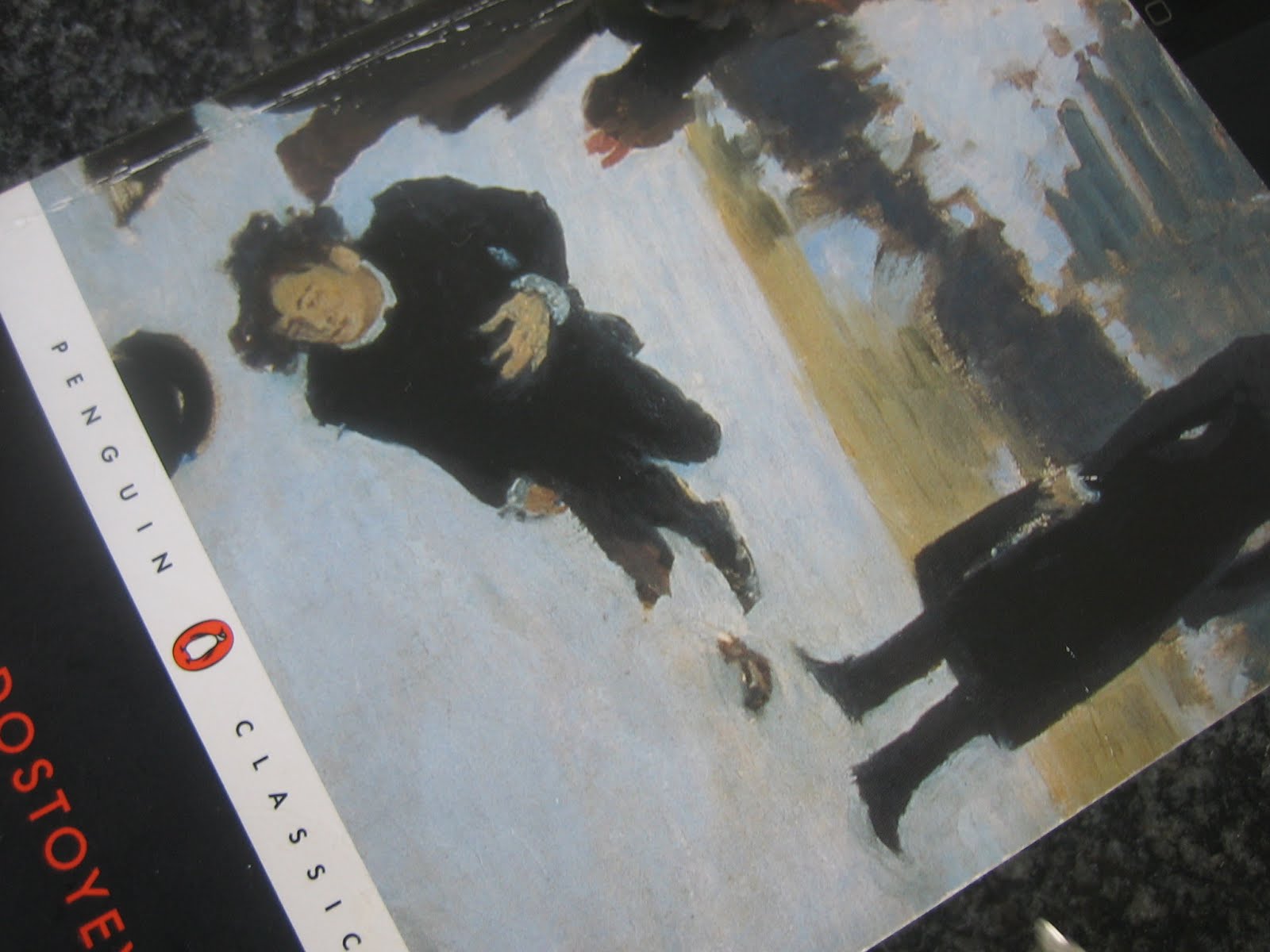
Dostoyevsky – The Devils.


The book begins with Like vii 32-36:
“And there was there an herd of many swine feeding on the mountain: and they besought him that he would suffer them to enter into them. And he suffered them. Then went the devils out of the man, and into the swine: and the herd ran violently down a steep place into the lake, and were choked. When they that fed them saw what was done, they fled,nd went an told it in the city and in the country. Then they went out to see what was done; and came to Jesus, and found the man out of whom the devils were departed, sitting at the feet of Jesus, clothed and in his right mind: and they were afraid. They also which saw it told them by what means he that was possessed of the devild was healed.” (Dostoyevsky, 1953, p.0).

A story that is often used by Rene Girard as an example for the scapegoat mechanism as opposed to Christ’s forgiveness: “If it is by the spirit of god that I cast out demons, the soon there will be no more demons or expulsions for the kingdom of violence and expuslion will rapidly be destroyed. (…) Instead of casting it out he (Jesus) is himself cast out, thereby revealing to men the mystery of expulsion” (Girard, 1986, p.190).

Dostoyevsky’s characters in the Devil try to ‘cast out the demons’ by accepting their own suffering and make themselves suffer as much as possible. Stavrogin, for example:
“’I want to forgive myself. That is my chief purpose, my only purpose!’ Stavrogin said suddenly, with gloomy rapture in his eyes. ‘I know that only then will the apparition vanish. That is why I seek boundless suffering. Seek it myself.’ (…)
‘If you believe,’ Tikhon exclaimed rapturously, ‘that you can forgive yourself and obtain forgiveness for yourself in this world through suffering, if you set that purpose before you with faith, then you believe in everything already. Why, then, did you say that you did not believe in God?’
Stavrogin made no answer.
‘God will forgive you for your unbelief, for you respect the Holy Spirit without knowing him.’” (Dostoyevsky, 1953, p.703).

There is another stream of thought in the book, most prominently declared by Shatov: he suffers as well, but only to prove his free will over God:

“’What deters people from committing suicicide in your opinion?’ I asked. (…) ‘I-I’m afraid I don’t know much yet. Two prejudices deter them. Two things. Two only. One a very little one, and the other a very big one. But the little one is also big.’
‘What is the little one?’
‘Pain.’ (…)
‘Well, an what is the second reason, the big one?’
‘The next world!’
‘You mean punishment?’
‘Makes no difference. The next world – just the next world.’” (Dostoyevsky, 1953, p.125).
“’He who conquers pain and fear will himself be a god. And that other God will not be.’
‘So, according to you, the other God does exist, after all?’
‘He doesn’t exist, but He is. There’s no pain in a stone, but there is pain in the fear of a stone.’” (Dostoyevsky, 1953, p.126).

“’If there is a God, then it is always His will, and I can do nothing against His will If there isn’t, then it is my will, and I am bound to express my self-will.’
‘Self-will? And why are you bound?’
‘Because all will has become mine. Is there no man on this planet who, having finished with God and believing in hs own will, will have enough courage to express his self-will in its most important point? It’s like a beggar who has inherited a fortune and is afraid of it and does not date to go near his bag of gold, thinking himself too weak to own it. I want to express my self-will. I may be the only one, but I’m going to do it.’
‘Do it!’
‘I’m bound to shoot myself, because the most important point of my self-will is to kill myself.’
‘But you’re not the only one to kill yourself. There are lots of suicides.’
‘Those have a motive. I’m the only one to do it without any motive, but simply of my free will.’” (Dostoyevsky, 1953, p.613).

At the end of the book both character, Stavrogin and Shatov, commit suicide. The latter to declare his free will over god, and the other to finally suffer enough, to overcome his guilt.

Both do not manage to overcome the scapegoat meachnism: one simply tries to suffer for his already committed sins. Thus he can’t reveal the scapegoat mechanism – since he is guilty. Only an innocent vicim canreveal the mechanism. Shatov, on the other hand commits suicide to prove his free wil. He is so self interested in his ‘perfect free will’, that he doesn’t care, what other think of him. To prove that he signs a letter saying he was responsible for a murder. Being completely egocentric, no one will ever know of his innocent suicide (his innocence is perversely only know to the murderers)and thus his disinterest in other people makes him fail to reveal the scapegoat mechanism.

The both are close to unvealing the scapegoat mechanism, and there are passages in the book, that indicate that they found it.

“’Perhaps I haven’t been fair to them! We are all to blame, we are all to blame and – if only we were all convinced of that!’” (Dostoyevsky, 1953, p.580).

But the tragedy of the book is, that none of the characters finally reveals it. “My desires are never storng enough. They cannot guide me.” (Dostoyevsky, 1953, p.666).