Sunday, 30 June 2013

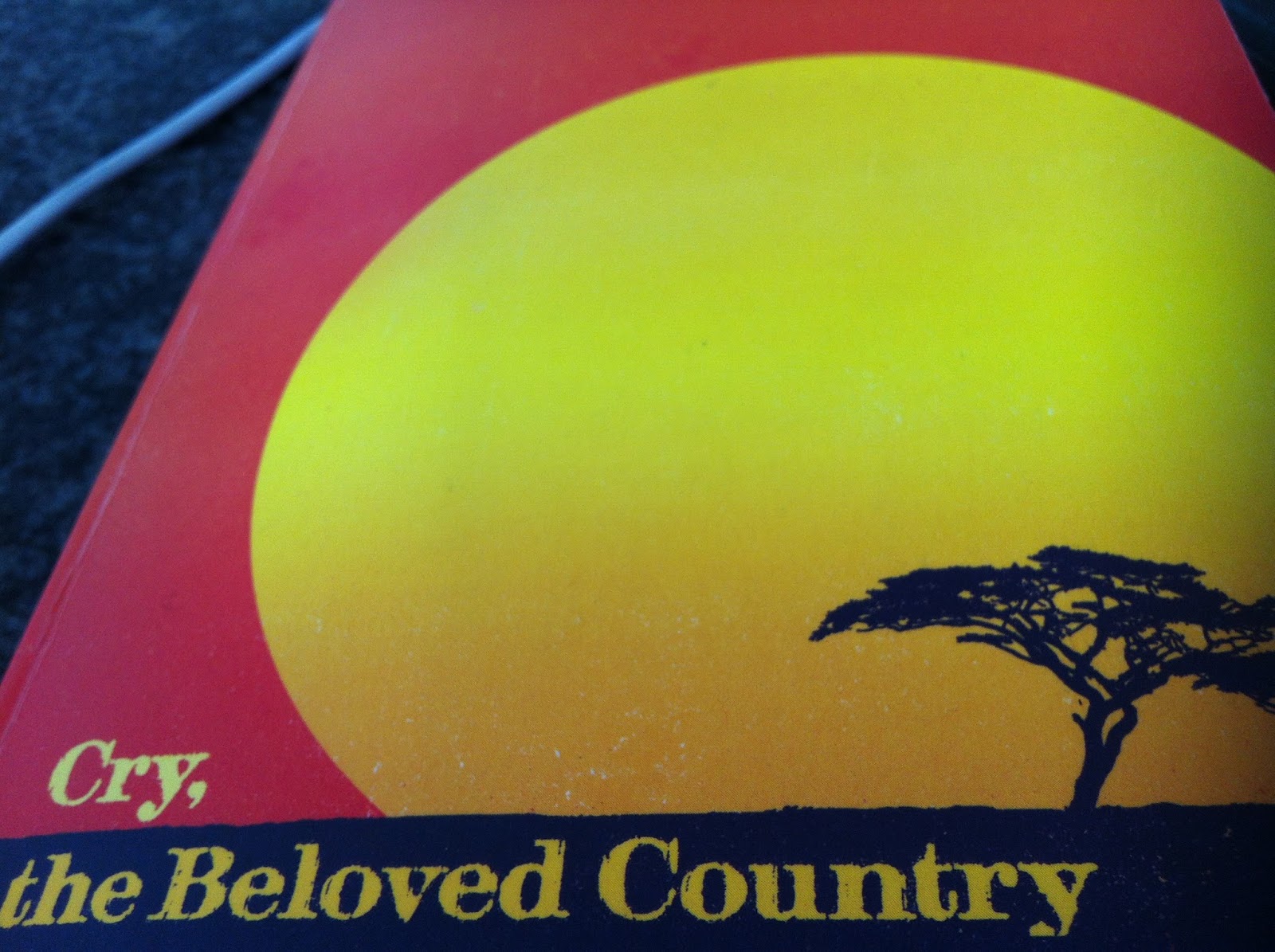
Cry, the beloved country – Alan Paton 1948


The story of a murderer in South Africa 1948. And how the father oft he murder and the father oft he victim, actually come to the same conclusion, unconditional compassion.


 “The grass is rich a matted, you cannot see the soil. It holds the rain and the mist, and they seep into the ground, feeding the streams of every kloof. It is well-tended, and not too many cattle feed upon it; not too many fires burn it, for the ground is holdy, being even as it came from the Creator. Keep it, guard it, care for it, for it keeps men, guards men, cares for ment. Destroy it and man is destroyed.
Where you stand the grass is rich and matted, you cannot see the soil. But the rich green hills break down. They fall to the valley below, and falling, change their nature. Or they grow red and bare; they cannot hold the rain and the mist, and the strea,s are dry in the kloofs. Too many cattle feed upon the grass, and too many fires have burned it. Stand shod upon it, for it is coarse and sharp, and the stones cut under the feet. It is not kept, or guarded, or cared for, it no longer keeps men, guards men, cares for men. The titihoya does not cry here any more.” (Paton, 1948, p.7).

“And he told them all about these places, of the great hills and valleys of that far country. And the love of them must have been in his voice, for they were all silent and listened to him. He told them too of the sickness of the land, and how the grass had disappeared, and of the dongas that ran from hill to valley, and valley to hill; how it was a land of old men and women, and mothers and children; how the maize grew barely to the height of a man; how the tribe was broken, and the house broken, and the man broken; how when they went away many never came back, many never wrote any more. How this was true not only in Ndotsheni, but also in the Lufafa, and the Inhlavini and the Umkomaas, and the Umzimkulu. But of Gertrude and Absalom he said nothing.” (Paton, 1948, p.22).

“The tragedy is not that things are broken. The tragedy is that they are not mended again. The white man has broken the tribe.” (Paton, 1948, p.25).

“He seeks power and money to put right what is wrong, and when he gets them, why, he enjoys the power and the money. Now he can gratify his lusts. (…) But there is only one thing that has power completely, and that is love. Because when a man loves, he seeks no power and therefore he has power.” (Paton, 1948, p.37).

“Cry, the beloved country, for the unborn child that is the inheritor of our fear. Let him not love the earth too deeply. Let him not laugh too gladly when the water runs through his fingers, nor stand too silent when the setting sun makes re the veld with fire. Let him not be too moved when the birds of his land are singing, nor give too much of his heart to a mountain or a valley. For fear will rob him of all if he gives too much.” (Paton, 1948, p.72).

“For some hours he sat there in the sun, and whether it was the warmth of it, or the sight of the wide plain beneath stretching away to blue and distant mountains, or the mere passage of time, or the divine providence for the soul that is distressed, he could not say; but there was some rising of the spirit, some lifting of the fear.” (Paton, 1948, p.77).

 “And while there is life, there is hope for amendment of life.” (Paton, 1948, p.94).

“When Kumalo had sat down, Father Vincent said to him, Yes, I said pray and rest. Even if it is only words that you pray, and even if your resting is only a lying on a bed. And do not pray for yourself, and do not pray to understand the ways of God. For they are secret. Who knows what life is? – for life is a secret. And why you have compassion for a girl, when you yourself find no compassion? – that is a secret. Any why you go on, when it would seem better to die? – that is a secret. Do not pray and think about these things now, there will be other times. Pray for Gertrude, and for her child, and for the girld, that is to be your son’s wife, and for the child that will be your grandchild. Pray for your wife and all at Ndotsheni. Pray for the woman and the children that are bereaved. Pray for the soul of him who was killed. Pray for us at the Mission House, and for those at Ezenzeleni, who try to rebuild in a place of destruction. Pray for your own rebuilding. Pray for all white people, those who do justice, and those who would do justice if they were not afraid. And do not fear to pray for your son, and for his amendment.
- I hear you.” (Paton, 1948, p.98).

“- And give thanks where you can give thanks. For nothing is better.” (Paton, 1948, p.98).

“ -I am no saintly man, said Jarvis fiercely.
- Of that I cannot speak, but God put His hands on you.
- And Jarvis said, That may be, that may be. He turned suddenly to Kumalo. Go well, umfundisi. Throughout this night, stay well.” (Paton, 1948, p.232).

“It was Msimangu who had said, Msimangu who had no hate for any man, I have one great fear in my heart, that one day when they turn to loving they will find we are turned to hating.” (Paton, 1948, p.235).

I have never been to South Africa, but with this book, I feel I had a glimpse into the culture and tension of this country in 1948.

Sunday, 16 June 2013

How brands become icons – Douglas B. Holt 2004


The most interesting point of this book, is that strategy cannever be something abstract and platonic. It needs to work with and make use of the culture and the society it lives in. The usual collection of abstract words isn’t a strategic decision. The most important strategic decision is, which role can such a brand play in society. Thus he takes strategy out of the realm of being useless and simply on paper into an area where it is useful. “From Abstract Associations to Cultural Expressions.” (Holt, 2004, p.36).

“the brand’s value resides in the specifics of the brand’s expression.” (Holt, 2004, p.36). “Managers cleanse their strategies to rid the brand of the messiness of society and history in search of its purified essence.” (Holt, 2004, p.37). They “deny the brand a role as a historical actor in society.” (Holt, 2004, p.37). ... and thus relevance. 

“cultural icons dominate our world.” (Holt, 2004, p.1). “Icons serve as society’s foundational compass points – anchors of meaning.
” (Holt, 2004, p.1). “Consumers flock to brands that embody the ideals they admire, brands that help them express who they want to be.” (Holt, 2004, p.4).

“Identity myths are usually set in populist worlds: places are separated not only from everyday life but also from the realms of commerce and elite control. The people living in populist worlds share  a distinctive ethos that provides intrinsic motivation for their action. (…) they do so because they want to, not because they are being paid.” (Holt, 2004, p.9).

“Iconic brands address acute contradictions in society.” (Holt, 2004, p.7). “identity myth: a simple story that resolves cultural contradictions.” (Holt, 2004, p.11).

“The brand is a historical entity whose desirablility comes from myths that address the most important social tensions of the nation.” (Holt, 2004, p.38).

“An iconic brand can’t behave like a cultural parasite (…). These brands must engage new popular culture as it unfolds. The key to success is for the brand team to carefully select new culture that can be credibly brought into the brand’s milieu, and then give these artifacts a new spin, inflecting them with the brand’s point of view.” (Holt, 2004, p.200). “Iconic brands are built by cultural activists, Yet, while many companies would love to create a Nike, a Budweiser, or a Mountain Dew, most are organized to act as cultural reactionaries.” (Holt, 2004, p.209).

Sunday, 9 June 2013

Auden – Poems 1976


Night Mail:
“And none will hear the postman’s knock
Without a quickening of the heart.
For who can bear to feel himself forgotten?” (Auden, 1976, p.38).


Death’s Echo
“The desires of the heart are as crooked as corkscrews,
Not to be born is the best for man;
The second –best is a formal order,
The dance’s pattern; dance while you can.
Dance, dance, for the figure is easy,
The tune is catching and will not stop;
Dance till the stars come down from the rafters;
Dance, dance, dance, till you drop.” (Auden, 1976, p.64).

As he is
“Fresh lovers betray him, every day
Over his green horizon
A fresh deserter rides away,
And miles away birds mutter
Of ambush and of treason;
To fresh defeats he still must move,
To further griefs and greater,
And the defeat of grief.”  (Auden, 1976, p.69).


In memory of Y.B. Yeats
“But for him it was his last afternoon as himself,
An afternoon of nurses and rumours;
The provinces of his body revolted,
The squares of his mind were empty,
Silence invaded the suburbs,
The current of his feeling failed; he became his admirers.” (Auden, 1976, p.76).

Many Happy Returns
“So I wish you first a
Sense of theatre; only
Those who love illusion
And know it will go far:
Otherwise we spend our
Lives in a confusion
Of what we say and do with
Who we really are.” (Auden, 1976, p.117).

“What limping devil sets our
Head and heart at variance,
That each time the Younger
Generation sails,
The old and wheather-beaten
Deny their own experience
And pray the gods to send them
Calm seas, auspicious gales?” (Auden, 1976, p.119).

“Love without desiring
All that you are not.” (Auden, 1976, p.120).

Prime
“Without a name or history I wake
Between my body and the day.” (Auden, 1976, p.196).

“I draw breah; that is of course to wish
No matter what, to be wise,
To be different, to die and the cost,
No matter how, is Paradise
Lost of course and myself owing a death.” (Auden, 1976, p.197).

The cave of making
“… Here silence
is turned into objects.” (Auden, 1976, p.209).

“… I wish you hadn’t
caught that cold, but the dead we miss are easier
to talk to: with those no longer
tensed by problems one cannot feel shy and, anyway,
when playing cards or drinking
or pulling faces are out of the question, what else is there
to do but talk to the voices
of conscience they have become? From now on, as a visitor
who needn’t be met at the station,
your influence is welcome at any hour in my ubiquity.” (Auden, 1976, p.211).

The common life
“… What draws
singular lifes together in the first place,
loneliness, lust, ambition
or mere convenience, is obvious, why they drop
or murder one another
clear enough: how they create, though, a common world
between them, like Bombelli’s
impossible yet useful numbers, no one
has yet explained. …” (Auden, 1976, p.225).

A change of air
“To go Elsewhere is to withdraw from movement;
A side-step, a short one, will convey you thither.” (Auden, 1976, p.227).

On the circuit
“Spirit is willing to repeat
Without a qualm the same old talk,
But Flesh is homesick for our snug
Apartment in New York.

A sulky fifty-six, he finds
A change of meal time utter hell,
Grown far too crotchety to like
A luxury hotel.” (Auden, 1976, p.230).

Lullaby
“Let your last thinks all be thanks.” (Auden, 1976, p.245).

Archaeology
“Knowledge may have its purposes,
but guessing is always
more fun than knowing.” (Auden, 1976, p.249).

Sunday, 2 June 2013

The art of captaincy - Mike Brearly


“In Cricket, the role of the captain has been consistently underrated in recent years. This should hardly surprise us. We have been living in an era in which the measurable has increasingly become the predominant mode of valuation.” (Brearly, 1985, p.1).


one key role of the captain is “willing to take in and think about the anxiety of those who work in the team.” (Brearly, 1985, p.4). “This function of containing anxiety and handing it back in a form that can be thought about.” (Brearly, 1985, p.4).

“there is no substitute for the leader’s capacity to bring people together in a common task, so that people come to take pleasure in their joint individual work.” (Brearly, 1985, p.7).

“A French general was once tactlessly asked, after a famous victory, if it hadn’t really been won by his second-in-command. He thought for some time before answering. ‘Maybe so,’ he replied. ‘But one thing is certain: if the battle had been lost I would have lost it.” (Brearly, 1985, p.10).

“Certainly the best play is not necessarily an adequate captain, any more than the best salesman makes a sales manager. Indeed, the outstandingly gifted may well find it difficult to understand the problems of the average performer in their field.” (Brearly, 1985, p.40).

“Towards the end of his career, his wish to ‘make things happen’ had an unsettling effect on the team, especially on the bowlers; for Brian found it hard to let things happen of their own accord, or to allow the bowlers to find a rhythm and to force a batsman into error by tying him down first.” (Brearly, 1985, p.41).

“But the building may first require demolition. Space may be needed for new acquisition or for the development of those already there.” (Brearly, 1985, p.58).

“It is no use having all the knowledge of technique in the world you don’t know, as a coach, how and when to impart it. There horse may not want to drink – or he may be unable to.” (Brearly, 1985, p.68).

“Cricket is so much a matter of confidence; no one can learn unless he believes that he can learn, and that he’s worth teaching. For a batsman very much out of form, Tiger’s instructions would often be that he should arrive early and have a long net, on a good wicket, with bowlers who bowled to his strengths. We need constantly to be reminded of our good qualities in order to get into a frame of mind which is suitable for amending our faults.” (Brearly, 1985, p.68-9).

“Too many wish to turn others into imitations of themselves.” (Brearly, 1985, p.70).

“Yet true fairness is hard to assess. It is simply foolish not to give your best bowlers the first chance on a helpful pitch. And you are bound to keep them going for longer before taking them off when you know how reliably they have taken wickets in such conditions in the past.” (Brearly, 1985, p.172).

“I have argued that an essential ingredient in good captaincy consists of a captain’s respect for his own team. I will end this chapter by remarking that the complete captain also shows respect for the crowd, the umpires and the opposition.” (Brearly, 1985, p.176).

“there is no point in brilliant tactical ideas if they flummox the bowler more than the batsman.” (Brearly, 1985, p.187).

 “Winning is not the be-all and end-all of sport. In cricket the captain has the prime responsibility for the standard of behaviour of the team.” (Brearly, 1985, p.237).

“I would support the now unfashionable view that one of cricket’s lessons for life is to teach its players to take the rough with the smooth and, in particular, to accept the umpire’s decisions, however erroneous.” (Brearly, 1985, p.248).

“However, people do have ideas on their own; and having fairly regular forums in which they can be expressed has the benefits for everyone. The captain has the benefit of ideas from all sources. If they differ from his, he discovers where the opposition lies, and what form it takes. Players learn the habit of thinking for themselves, and not only about their own specialism.” (Brearly, 1985, p.259).

“As captain, one needs several steadily reliable players who are willing to give advice sulking if one does not follow it.” (Brearly, 1985, p.262).

“justice does not reduce so simply to the same treatment for each individual, since different individuals have different needs.” (Brearly, 1985, p.265). “he would ask himself eachday what the members of the party wanted from him.” (Brearly, 1985, p.266).

“Nevertheless, whatever the captain’s style, he must let the team know he is pleased with them when they do well, and feels for them when not. His concern may surprise. I was quite touched when, a week after the event, Greig told me that he could have cried when I ran myself out early in the Delhi.” (Brearly, 1985, p.266).

 “on one point they would all agree. A captain must instill the will to win.” (Brearly, 1985, p.273).

Wednesday, 29 May 2013

War and Peace - Leo Tolstoy


This book about young aristocratic Russians in the time of the Napoleonic war  is certainly beyond my complete comprehension. Hence I’ll focus on 2 themes that stood out to me: power and the pursuit of happiness.


The war provides the perfect background to explore the theme of power and influence over people. „war began. In other words, an event took place which defied human reason and all human nature. Millions of men set out to inflict on one another untold evils – deception, treachery, robbery, forgery, counterfeiting, theft, arson and murder – on a scale unheard of in the animals of law-courts down the centuries and all over the world, though at the time the men responsible did not think of these deeds as crimes.“ (Tolstoy, 1868, p.667). „Every last man oft hem clearly knew beyond doubt they were all criminals, and they had to move quickly to hide all traces of their crime.“ (Tolstoy, 1868, p.1073).

It is power that binds people together in groups: “Pierre could not see these people as individuals; he saw them all together and in movement.“ (Tolstoy, 1868, p.1131).
„There are two sides to life for every individual: a personal life, in which his freedom exists in proportion to the abstract nature of his interests, and an elemental life within the swarm of humanity, in which a man inevitable follows laws laid down for him.“ (Tolstoy, 1868, p.669).

But power is not simple: Leaders can’t order and events will happen. Orders don’t correspond to events.
“From the incalculable series of Napoleon’s orders that were never carried out, one series of orders that were carried out, not because of any essential difference between these and the ones not carried out, but simply because this series happened to correspond with the course of events bringing the French soldiers into Russia.” (Tolstoy, 1868, p.1337).

„It was necessary for those millions of men who wielded the real power – soldiers, shooting or bringing up supplies and guns – to do what they were told by one or two feeble individuals.“ (Tolstoy, 1868, p.669). „If any of these causes had been missing, nothing could have happened.“ (Tolstoy, 1868, p.669).

So what is the role of leader and what is the role of those being led - the leaders provide the moral: „Since time began and men started killing each other, no man has ever committed such a crime against one of his fellows without comforting himself with the same idea. This idea is ‚the public good’, a supposed benefit for other people. No person in control of his passions is ever aware of this benefit, but a man fresh from committing such a crime always knows certain where the benefit lies. Rostropchin knew.“ (Tolstoy, 1868, p.990).

“(1) Power is a relationship between a given person and other persons by which the less directly a person participates in a collective enterprise the more involved he is in expressing opinions and theories about it and providing justification for it.” (Tolstoy, 1868, p.1341).

“(2) The movement of peoples is determined not as historians have supposed, by the exercise of power or the intellect or both together, but by the actions of all involved; all the people who come together in such a way that those who participate most directly in the activity assume the least responsibility for it and vice versa.” (Tolstoy, 1868, p.1341). “But these justifications are very necessary at the time, shifting moral responsibility away from the men who produce the events. These short-term measures operate like brushes on the front of a train clearing the rails ahead.” (Tolstoy, 1868, p.1339).

“In moral terms power is the cause of the event; in physical terms it is those who are subject to that power.” (Tolstoy, 1868, p.1341).

The second theme is the pursuit of happiness or a purpose in life: The main characters live in Russian aristocratic society - a society that favours shallowness and vanity.

Instinctively the main characters know, that this is no way of living and is the source of their unhappiness. When Andrey Bolkonsky lies severely wounded on the battle field: „How can it be that I’ve never seen that lofty sky before? Oh, how happy I am to have found it last. Yes! It’s all vanity, it’s all an illusion, everything except that infinite sky. There’s nothing, nothing – that’s all there is. But there isn’t even that. There’s nothing but stillness and peace. Thank God for that!“ (Tolstoy, 1868, p.299).

So all main characters in the book look for a purpose in life and they try out pretty much everything – a journey through plenty of philosophical ideas. But all of them fail – but towards the end Tolstoy develops his unique way.

A main source of happiness is the feeling of being part of a whole and containing this whole in oneself: „Pierre glanced up at the sky and the play oft he stars receding into the depths. ‚And it’s all mine and it’s all within me, and it all adds up to me!’ thought Pierre.“ (Tolstoy, 1868, p.1134).  In a dream Pierre recognizes this idea clearer: “’Wait a minute,’ said the little old man. And he showed Pierre a globe. This globe was a living thing, a shimmering ball consisted of drops closely compressed. And the drops were in constant movement and flux and sometimes dissolving from many into one, sometimes breaking down from one into many. Each drop was trying to spread out and take up as much space as possible, but all the others, wanting to do the same, squeezed it back, absorbing it or merging into it. ‘This is life,’ said the little old teacher. (…) God is in the middle and each drop tries to expand and reflect Him on the largest possible scale. And it grows, gets absorbed and compressed, disappears from the surface, sinks down into depths and bubbles up again. That’s what happened to him, Karatayev: he has been absorbed and he’s disappeared.” (Tolstoy, 1868, p.1185).

Being part of a whole and containing it, leads to unconditional love of the world:
„’Yes, it’s love ...’ (his thoughts were lucidity itself), ‚but not the kind of love that loves for a reason, a purpose, a cause, but the kind of love I felt for the first time when I was on my death bed and I saw essence of the soul, love that seeks no object. (…)  .... When you love with human love you can change from love to hatred, but divine love cannot change. Nothing, not even death, nothing can destroy it. It is the essence of the soul.“ (Tolstoy, 1868, p.1021).

Unconditional love also implies the danger of being indifferent to the world and life:
„Karatayev enjoyed no attachements, no friendships, no love in any sense of these words that meant anything to Pierre, yet he loved and showed affection to every creature he came across in life, especially people, no particular people, just those who happened tob e there before his eyes. He loved his dog, his comrades, the French, and he loved Pierre, his neighbour. But Pierre felt that for all the warmth and affection Karatayev showed him (an instinctive tribute to Pierre’s spirituality), he wouldn’t suffer a moment’s sorrow if they were to part.“ (Tolstoy, 1868, p.1080).


Thus there is a catch to this principle uncondititional love. It more or less means renouncing life. „Loving everything and everybody, always sacrificing oneself for the sake of love, meant loving no one person, and not living this earthly life. And the more he absorbed this principle of love, the easier he found it to renounce life, and the more effectively he destroyed the dreadful barrier that the absence of love sets up between life and death.“ (Tolstoy, 1868, p.1091).

Thus love should be unconditional but it never ends up being undiscriminating. The character who live a happy life in ‘War and Peace’ always find a partner that they cannot help but love more than the rest of the world. „It was a sudden awareness that life, seen though his love for Natasha, was still precious.“ (Tolstoy, 1868, p.1091). „’Love gets in the way of death. Love is life. Every single thing I understand, I understand only because I love. Everything is – everything exists . only because I love. Everything is bound up with love, and love alone. Love is God, and dying means me, a tiny particle of love, going back to ist universal and eternal source.’“ (Tolstoy, 1868, p.1093).

So in the end, this love means restriction in the world. So for Tolstoy happiness doesn’t exist in freedom, but in restriction: „It was Natasha, and he loved her. (...) By now Pierre’s embarrassment had almost disappeared, but he felt that all his former freedom had disappeared with it. He felt that now there was a judge listening to his every word and every action, someone whose judgement mattered more than the judgement of everybody else in the world.“ (Tolstoy, 1868, p.1241).

And this restriction applies not only to love, but also to the material world:
„It was only here and now that Pierre had fully appreciated fort he first time in his life the enjoymentof eating when you are hungry, drinking when you are thirsty, sleeping when you are tired,keeping warm when it is cold and talking to a fellow creature when you feel like talking and you want to hear men’s voices. Through deprivation Pierre now saw the satisfaction of his basic needs – good food, cleanliness and freedom – as the ultimate happiness, and the choice of an occupation or lifestyle, now that this choice was so restricted, seemed such a simply matter that he forgot that a surfeit of luxury takes all the pleasure oout of satisfying our basic needs and maximum freedom in the choice of occupation, which had been provided for him through education, wealth and his position in society makes the actual choice of an occupation extraordinarily difficult, because it destroys the need and desire for any such thing.“ (Tolstoy, 1868, p.1126).

“In his prison shed Pierre had learnt, though his whole being rather than his intellect, through the process of living itself, that man was created for happiness, and happiness lies within, in the satisfaction of natural human needs, and any unhappiness arises from excess rather than deficiency. (…) He had learnt that just as there is no situation in the world in which a man can be happy and perfectly free, neither is there any situation in which he should be unhappy and not free. He had learnt that there is a limit to suffering and a limit to freedom, and those limits are never far away (…) He learnt that when he had married his wife by his own free will (so he had thought), he had been no freer than he was now when they locked him up in a stable for the night.” (Tolstoy, 1868, p.1179).

The best purpose in life is no purpose “And from habit he would start asking himself questions. ‘What comes next, then? What am I going to do?’ And immediately he knew the answer: ‘Nothing, I’m just going to live. Oh, it’s marvellous!’. And it was the lack of any purpose that gave him the complete and joyous sense of freedom underlying his present happiness. He could seek no purpose now, because now he had faith – not faith in principles, words or ideas, but faith in a living God of feeling and experience.” (Tolstoy, 1868, p.1230).